
Claude Video Generator: How "Make a Video With Claude" Actually Works
A Claude video generator makes no pixels — Claude writes code that renders to video. How it works, the Opus 5.5 viral wave, and what it is honestly good at.

Type "claude video generator" into a search box and you get two kinds of results that disagree with each other. One kind shows dazzling animations — kinetic typography, animated charts, 3D scenes — with captions claiming Claude made them from a single prompt. The other kind, including Anthropic's own materials, shows no video generator at all: Claude's official capabilities are text, code, reasoning, and agent work. Both are telling the truth, and untangling how is the whole point of this article.
The short version: Claude does not generate video. It has no video model, the way it has no camera. What people call a "Claude video" is Claude writing code that renders into video — or Claude orchestrating someone else's generation model. That distinction sounds pedantic until you try to pick a tool, because the code route is spectacular at motion graphics and helpless with real footage. This guide covers how the mechanism works, why it went viral in the fall of 2026, what the outputs are honestly good for, and where to go if your actual job is editing footage you've shot (that's a different route, mapped in how to edit videos with Claude).
What "Claude Generates a Video" Physically Means
Start with what Anthropic actually ships: a language model. Ask Claude for a video and it returns the only things it can return — words and code. The trick that made "Claude video" a phenomenon is that video can be specified as code.
The pipeline looks like this. You describe a scene to Claude Code or Claude in a coding session. The model writes a program — HTML and CSS with animated canvas elements, SVG, Three.js scenes, or a component tree in a video framework like Remotion or HyperFrames. The framework executes that program frame by frame, deterministically, and encodes the frames into an MP4. Claude never touches a pixel; it writes the recipe, and a renderer does the cooking.
This is why the outputs look the way they do. Code is a natural medium for typography that lands on a beat, bars that grow to numbers, mockups that assemble themselves, diagrams that draw their own arrows — anything with clean geometry and timed motion. It is a hopeless medium for "make my kitchen look cinematic" or "cut the dead air from my podcast," because code doesn't contain your kitchen or your podcast. When a voiceover is needed, creators pipe in a TTS service like ElevenLabs and have Claude script and sync it — still no generation model required.
One more piece of honesty: some tools marketed as "Claude video generators" are really Claude plus a third-party video model, with Claude writing the prompts that steer it. That's a legitimate architecture — an orchestrator wrapping a diffusion model — but the pixels come from the other model, and the quality ceiling is that model's, not Claude's. Check which architecture a tool uses before crediting Claude with its demo reel.
Why the Wave Happened: Opus 5.5 and September 2026
Code-as-video existed before 2026 — Remotion has been rendering React into MP4s for years. Three things converged to turn it into a visible wave.
The first was a model that could hold a whole video in its head. Claude Opus 5.5, released September 22, 2026, sustains long, coherent code better than its predecessors, and at $4 per million input tokens and $20 per million output tokens, iterating on a 500-line scene costs pocket change. A render pipeline only goes viral when the iteration loop is cheap enough to run forty times; Opus 5.5 pricing made it casually cheap.
The second was agent-ready scaffolding. HeyGen open-sourced HyperFrames — "Write HTML. Render video. Built for agents." — which by late September 2026 had accumulated roughly 54,000 GitHub stars; palmier-io/palmier-pro, an AI-native Mac video editor built to be driven by agents like Claude Code, sits around 14,000. Free, agent-shaped tools remove the last excuse.
The third is measurable community momentum:
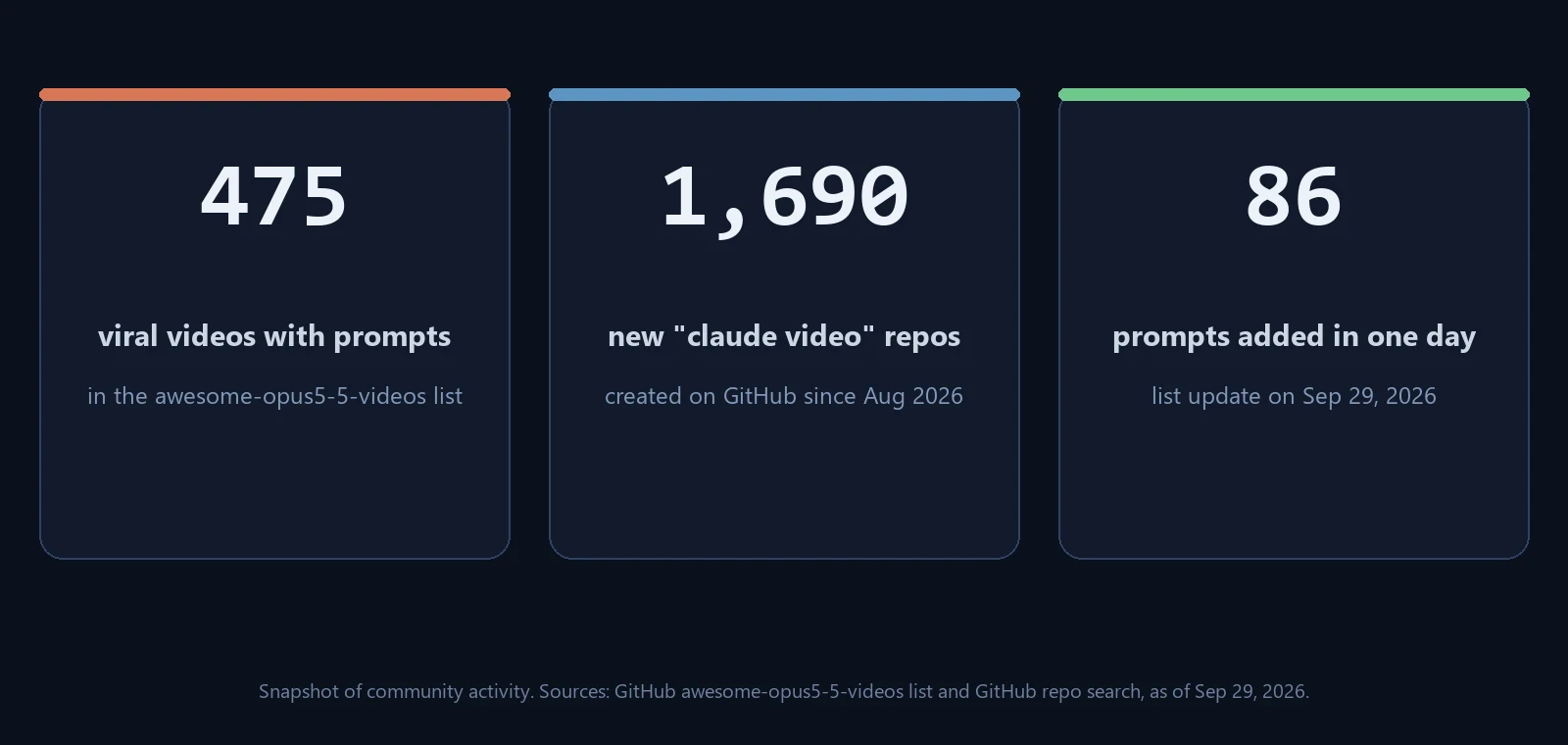
The reference point for that wave is the awesome-opus5-5-videos list on GitHub, which collects viral videos made this way along with the exact prompt that produced each one — 475 of them as of September 29, 2026, with 86 added that day alone. GitHub searches for "claude video" surface about 1,690 repositories created since August. When a technique gets its own awesome-list growth curve, it has stopped being a trick and become a genre.
What a Claude Video Is Actually Good For
The honest quality map, based on what the format can and cannot express:
Strong fits are anything that is fundamentally information design in motion: product explainers, feature walkthroughs with animated UI, data stories and animated charts, title sequences, lyric-style typography, looped social posts built around one visual idea. In the awesome-list categories, motion graphics and explainer formats dominate, which is the ecosystem telling you the same thing. Iteration is the underrated superpower — because the video is code, "make the bar chart 20% faster" is a one-line change and a re-render, not an afternoon in a timeline.
The weak spots follow from the medium. Photorealism is off the table unless a diffusion model is doing the pixels. Continuity with real footage is absent — code-rendered scenes don't cut together with your camera roll without manual work. Emotional texture is thin: a thousand viral examples are clever, few are moving. And the variance is brutal. The 475-prompt list exists precisely because the hit rate per generation is low; every creator curates, re-rolls, and hand-picks. The genre's own highlight reel is a survivorship-flavored sample of Claude's best at-bats, and the prompts are published because most attempts need several tries.
That last point deserves emphasis because the marketing around "one prompt, whole video" skips it: quality control is manual, per clip, always. If you can't tell a good easing curve from a bad one, the code route will hand you confident-looking output that animates slightly wrong.
Where This Is Heading
Two signals are worth watching, with dates attached. YouTube's conversational editing tool, announced September 23, 2026 and covered by TechCrunch, shows the interaction pattern — describe the change, get the result — being absorbed into mainstream creator tooling. And Anthropic itself keeps shipping agentic surfaces like Cowork without ever claiming video output, which suggests the durable division of labor: Claude plans and writes, dedicated engines render or generate.
The boring prediction is that "Claude video" stops being a novelty category and becomes an input method — the way you specify motion graphics and, separately, the way you brief footage edits. The interesting open question is whether code-rendered and model-generated video converge, with agents stitching diffusion clips into coded timelines. Neither is here yet, and both would change this article's advice, so treat any guide on this topic — including this one — as a dated snapshot.
From Generating to Editing
If you came here with footage rather than a blank canvas, the summary is one sentence: Claude can help you edit that footage too, but through a completely different set of tools — MCP servers driving real editors like DaVinci Resolve or Premiere, or hosted conversational editors you upload clips into. The three-route guide to editing videos with Claude maps those options, their setup costs, and which one fits your skills. Generating from nothing and editing what exists are becoming two sides of the same interface — but they are still two different toolchains, and choosing the right one is most of the battle.
https://sparki.io/blog/claude-video-generator