
How Jenn Im's 'What My Son Eats' Short Is Structured, and What Transfers
How Jenn Im's 'what my son eats' Short is structured: three meals as three acts, payoff and leftover-plate beats, and what transfers to your own footage.

Watch Jenn Im's Short "What my son eats" once and it reads as effortless lifestyle content: a mother feeding her toddler in a bright kitchen, an ordinary hour condensed to sixty seconds. Watch it again with a finger on the progress bar and a different object appears — three meal segments of nearly equal dramatic weight, each one ending on a beat that has nothing to do with food, arranged in an order that escalates rather than repeats. The video that feels casual is one of the more carefully structured pieces of lifestyle short-form you can study.
This article is the structure-level breakdown of that single Short: what each segment does in sequence, why the cheese pull and the leftover plates sit exactly where they sit, and why this format works as a repeatable series instead of a one-off hit. The shot-level view — cuts, framing, sound mix, product placement — of a sibling video in the same series lives in our companion breakdown of how Jenn Im documents toddler meals; the two analyses deliberately do not overlap. One caution before the praise piles up: everything here is observation of public videos with dated numbers, not a formula. Structure holds attention; it does not distribute videos, and no breakdown of someone else's success should be mistaken for a growth plan.
The Sample, and What "Worked" Means Here
The object under analysis, so you can watch it before reading further:
Video: "What my son eats" — YouTube Short, roughly 60 seconds Stats snapshot (June 2026, when we first analyzed it): 387,647 views, 5,270 likes, 46 comments Channel context (October 2026): @imjennim, about 3.23 million subscribers and 809 uploads
That calibration matters more than the word "viral" suggests. On a channel of 3.2 million subscribers, a Short finishing just under 400K views is a strong routine performer, not a freak outlier — and that is precisely what makes it worth studying. A freak accident teaches nothing; a dependable performer implies a dependable structure. Supporting the point: a second video in the same format, a different day with entirely different meals, drew roughly 148K views at its own snapshot (covered shot-by-shot in the companion article). Two samples do not prove a permanent style, and this breakdown does not claim one. They do show the format performing steadily across repetitions, which is the property actually worth reverse-engineering.
Three Meals, Three Acts
The container is a day; the acts are meals. Every act has the same internal job description — preparation, presentation, outcome — but a different emotional assignment, and the order is doing quiet work:
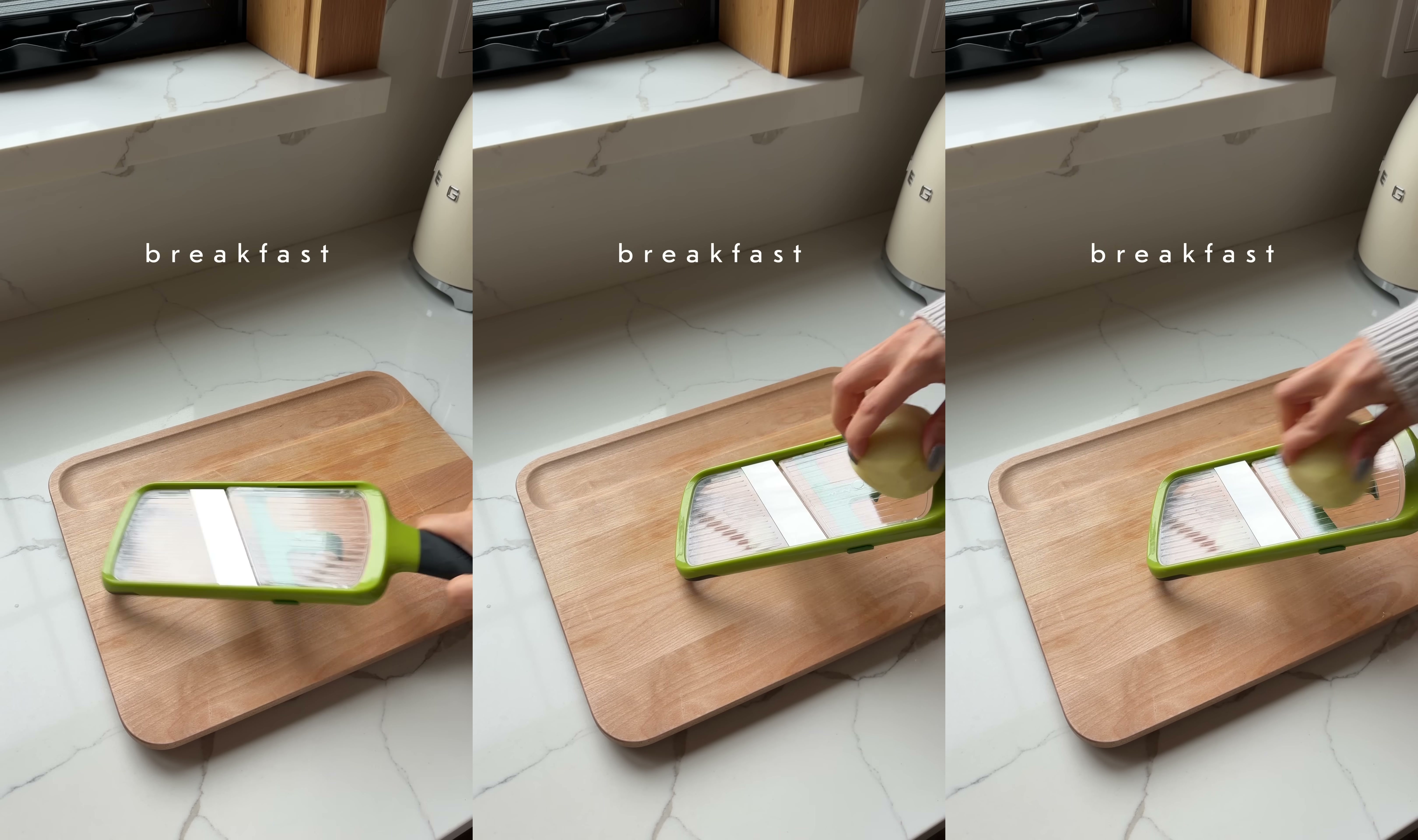
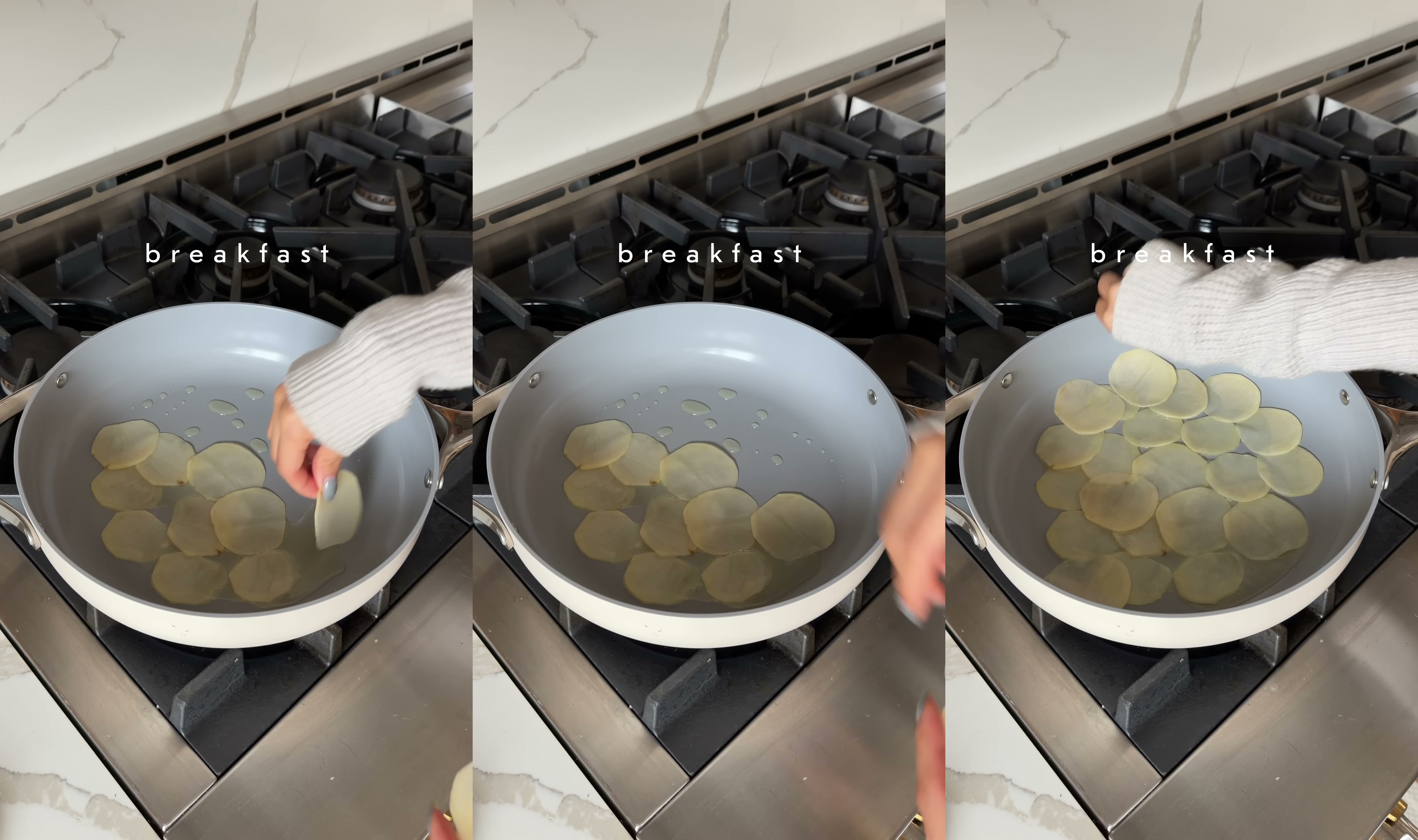
- Breakfast (0–29s). The longest act and the craft showcase: mandoline potato slices, a crispy potato-and-egg omelet, the flip, the cheese pull. Its job is to establish competence and sensory richness. You are being shown what this kitchen can do.
- Lunch (30–39s). The shortest act, played almost entirely in static top-down shots of bento assembly — rice, tuna salad, broccoli, fruit, the lid clicking shut. After breakfast's abundance, this act compresses: efficiency and order, minimal motion, maximal neatness.
- Dinner and close (40–60s). A purple porridge, then the register shifts entirely — the final beats belong to the child and the cuddle, not the food. The video ends on who the day was for.
Read as a sequence, the acts escalate intimacy: craft (look what I can make), then order (look how smoothly the day runs), then relationship (look who it is all for). Repeating the same emotional note three times would flatten the video by the second meal; escalation is why a 60-second clip about feeding a toddler sustains to the end.
The day-as-container also solves a problem most short-form creators create for themselves. Because every viewer already knows a day ends at dinner, the video never has to explain where it is going or manufacture a payoff promise. Known endpoints lower the cognitive cost of watching, and a lower cognitive cost is retention you did not have to edit in.
The Closing Beats: Cheese Pulls and Leftover Plates
Two recurring devices do the paragraph punctuation in this video, and both are placed with more intent than their casualness suggests.
The first is the payoff shot that ends a craft sequence. The cheese pull at ~28.5 seconds is the clearest example: after a montage of slicing and cooking, the moment the food is done, the stretch arrives. It functions as a sensory full stop — the reward for sitting through the process, delivered at the exact frame the process completes, from the hand of the person who made it (she eats the leftover omelet herself). The mandoline slicing pattern earlier in the act is the same device in miniature: a visual rhyme that says "craft" without a word of dialogue.
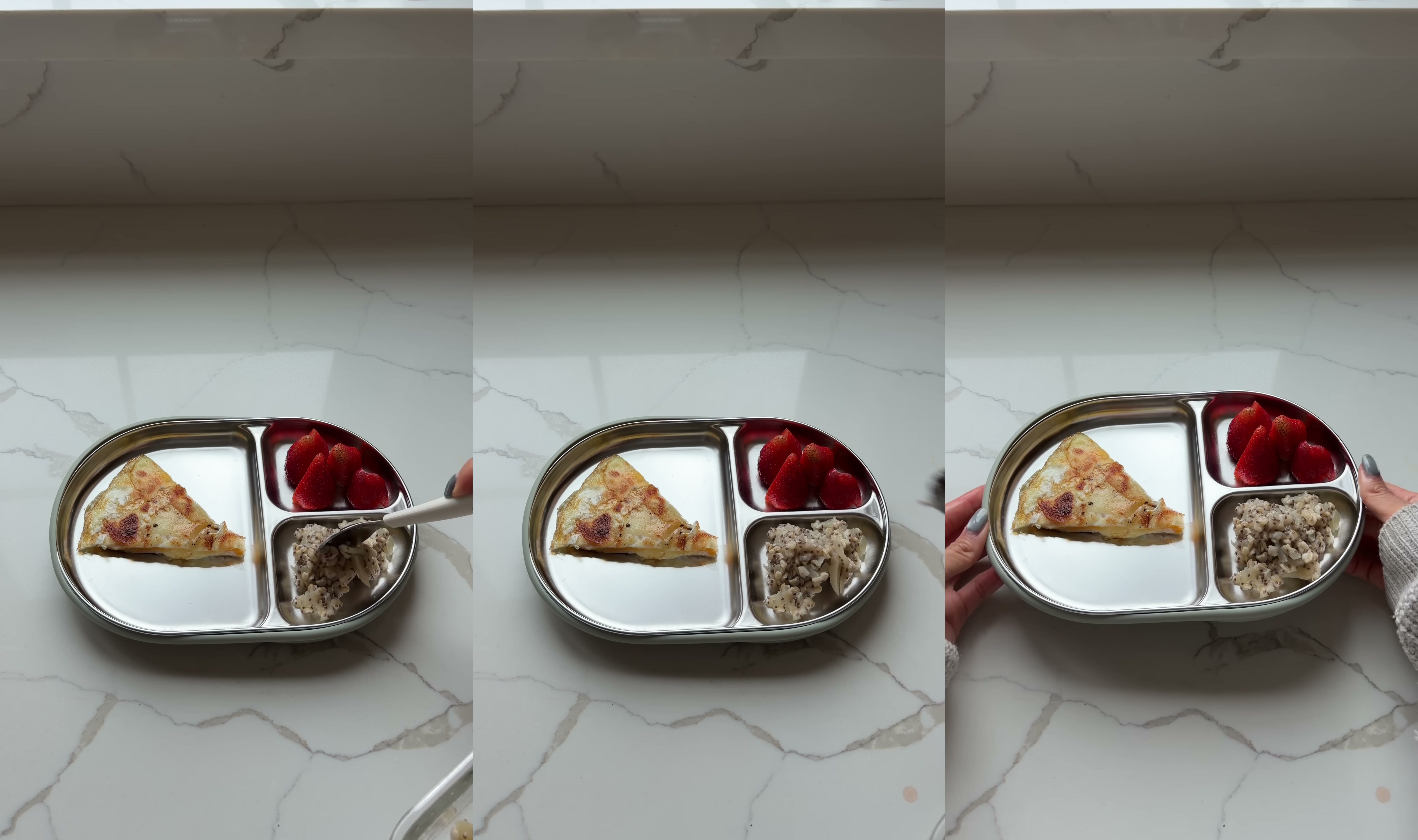
The second is the leftover plate. The "what's left" frames at ~27s and ~54s show the meal's remains — because toddlers, universally, do not finish their plates. The strategy-level function is a trust beat: an admission that the polished frames edited something out, placed immediately before the video asks for another block of your attention, and again at the close. Aspiration is what makes the video watchable; the honesty beats are what make it feel documented rather than performed — and they are the likelier driver of the follow, the comment, the send-to-a-parent-friend. They also cost nothing to produce, because the mess is already in the kitchen waiting to be filmed.
The sibling video runs the same beat through a different door — the "parent tax" moment of eating the discarded bread crusts — which is why its shot-level treatment lives in the toddler meals companion piece rather than here.
One Shoot Becomes a Series
The most under-discussed property of this format is that it is a series engine, not a video. Four structural reasons:
- The container is fixed. "A day, three meals" explains itself to a first-time viewer and needs no re-pitch to returning ones. Every episode arrives pre-labeled by its own format.
- The variables are cheap. Meals change, the child ages, the kitchen stays. The second observed video — sandwich breakfast, bento lunch, frozen pizza dinner — reuses the skeleton with almost entirely new content and zero new concept.
- The footage is bounded. A day of toddler feeding yields perhaps an hour of kitchen footage. That makes the format schedulable — three episodes a week is a calendar decision, not a production miracle — which is the quiet advantage over formats that depend on events, travel, or novelty.
- The endings vary on a fixed beat. Every act closes on either a payoff or a leftover, but the specific emotional close changes: a cuddle here, an eager grab there. The beat is the promise; the content of the beat is the surprise.
This is the real strategic difference between a viral video and a format. A spike is something that happens to you once; a repeatable structure converts each ordinary day into an episode with a defensible floor. The channel's upload history shows the format recurring across 2026, which is the observable evidence — the intention behind it belongs to the creator and stays speculation.
What Transfers — and What Doesn't
The useful question is not "how do I make Jenn Im's video." It is which parts of the skeleton survive contact with your niche, your footage, and your life on camera.
What transfers, into footage you already shoot:
- A fixed container your audience understands in advance — a day, a week, a numbered ranking, a room-by-room. The container does the navigational work so the content can do the emotional work.
- Fixed beats with escalating registers. Same segment shape each time, different assignment per segment: craft, then order, then relationship, or whatever ladder fits your subject.
- A sensory payoff as the segment's full stop, and one honesty beat per video. The payoff rewards the watch; the honesty beat earns the next one. Both belong at segment boundaries, where attention is renegotiated.
What does not transfer, and should not be attempted:
- The identity. The persona, the child, the kitchen, the aesthetic — copying any of these produces imitation, and short-form audiences identify imitation faster than any content-ID system. The skeleton is the copyable part precisely because it is impersonal.
- The material. Restaging or reusing her footage and meals builds nothing for your channel, separate from the rights question. Structure transfers; content does not.
- The numbers. 387K views ride on 3.2 million accumulated subscribers. Your episode starts at zero; the structure's job is holding the people who arrive, not manufacturing arrivals.
Where editing tooling honestly fits: if you want a rhythm like this applied to your own material, Sparki — the product we build, and one option among several — has a copy-style workflow that extracts the editing recipe from a reference (pacing, beat placement, cut density) and applies it to your footage; by design it learns the recipe, not the content, so nothing of Jenn's video or family ends up in yours. For assembling the three-beat structure itself, an agentic editor can draft the segment order and montages from a day's footage so you review pacing instead of building it by hand — what those editors do and do not automate is mapped in our AI video editor guide. The boundary worth repeating: no editor, ours included, makes content perform. Structure improves hold. Distribution is earned elsewhere, over time, by publishing.
A practical next step costs one viewing: rewatch the Short with the structure lens — mark where each act starts, where the payoff lands, where the leftover plate appears. Then shoot one ordinary day in your own kitchen, studio, or workshop, and cut it to the same beat sheet. The second video in that series is where you find out whether the skeleton holds your weight.
https://sparki.io/blog/jenn-im-viral-content-strategy