
How to Turn a Podcast into Shorts Without Losing Context
Learn how to turn podcast episodes into short-form videos without losing context, using a structure-first workflow built around setup, reasoning, and payoff.

A podcast clip can sound excellent inside the full episode and still fail as a standalone short.The line is still there. The guest still sounds sharp. The laugh still lands. But once the moment is removed from the conversation that produced it, something breaks. The clip feels abrupt. The meaning gets thinner. A viewer who never heard the surrounding discussion does not know why the moment matters.
That is the real failure mode in podcast repurposing.Most clipping workflows are built to find interesting moments quickly. They scan for spikes: laughter, emphasis, interruption, pacing changes, or transcript lines that look promising. That works when the moment is already self-contained. It works much less reliably when the value of the moment depends on what came before.Podcasts are conversations. A useful conversation has setup, reasoning, reaction, tension, and payoff. Remove the wrong part, and the clip stops feeling complete.
The problem is usually not that the tool failed to find a strong line. It is that the workflow assumed the strong line was already a complete short.
Why Podcast Clips Need Structure
When creators say, "That would make a great short," they are often reacting to more than the sentence itself.They may be reacting to the question that made the answer surprising, the setup that made the joke land, the disagreement that created tension, or the reasoning chain that made the conclusion persuasive.
Extraction-first workflows are not designed around those structures. They are designed around detectable signals. They can find moments that look important, but they do not always judge whether the moment is structurally complete.
That distinction matters.A clip can be engaging inside the original episode because the audience already has context. The same clip can feel weak in isolation because the audience now lacks the setup that made the moment meaningful.A strong podcast short usually needs three parts.
Setup
The viewer needs to know what the speaker is responding to.This can be the host's question, a short framing sentence, a conflict, a premise, or a topic setup. It does not need to be long. But without it, the clip can sound like it starts in the middle.
Reasoning or Reaction
Podcast value often lives in the middle of the exchange.The guest explains. The host clarifies. A cohost reacts. Someone pushes back. The speaker changes direction. A pause or laugh changes the meaning of the next line.Automated clipping can easily remove this layer because it looks less punchy than the payoff. But it is often the part that makes the payoff understandable.
Payoff
This is the line most clipping tools are good at finding.It may be the insight, joke, reversal, controversial take, or memorable phrase. But the payoff is not always the full clip. In many podcast shorts, the payoff is only the ending of the thought unit.
A useful way to think about this is simple: a strong podcast short is not just a good line. It is a complete thought unit.
The Problem Starts Before the Cut
The difference often appears before any cut is made.In a full-episode editing workflow, the system usually prepares the podcast first. It transcribes the video, removes filler words, labels speakers, inserts chapter markers, improves audio, adds captions, and then asks whether social clips or audiograms should be created afterward.That workflow is useful for cleaning and publishing a polished podcast episode. But it also reveals a hidden assumption: the short clip is a downstream output.The episode is the main object. The short is extracted later.
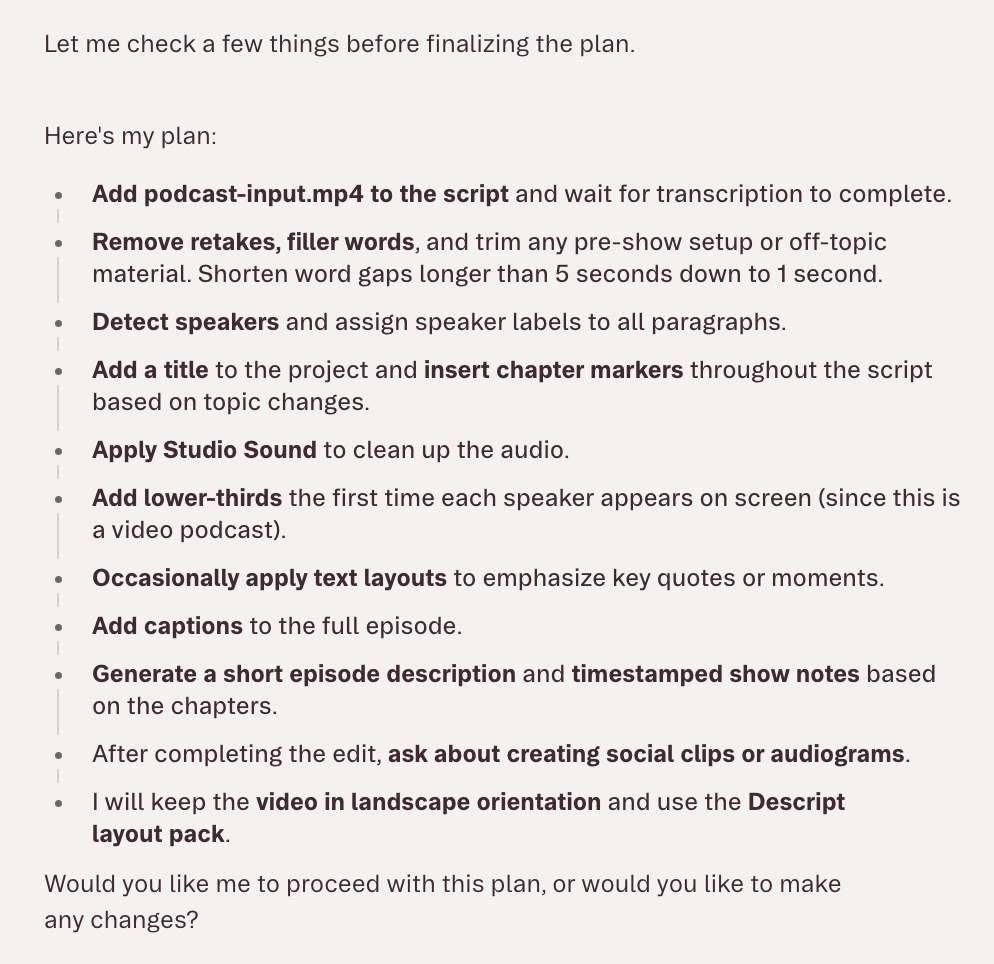
A full-episode editing workflow that prepares the podcast first, then treats social clips as a downstream output.
For podcast shorts, that assumption can create rework. By the time the clip is generated, the structure has already been organized around the full episode rather than around the standalone short.A short-first workflow starts from a different question:What should this short communicate on its own?Before editing, it defines the story, the hook, the key idea, the necessary context, and the viewing format. The clip is planned as a self-contained unit before the system locks into cuts, captions, zooms, and layouts.
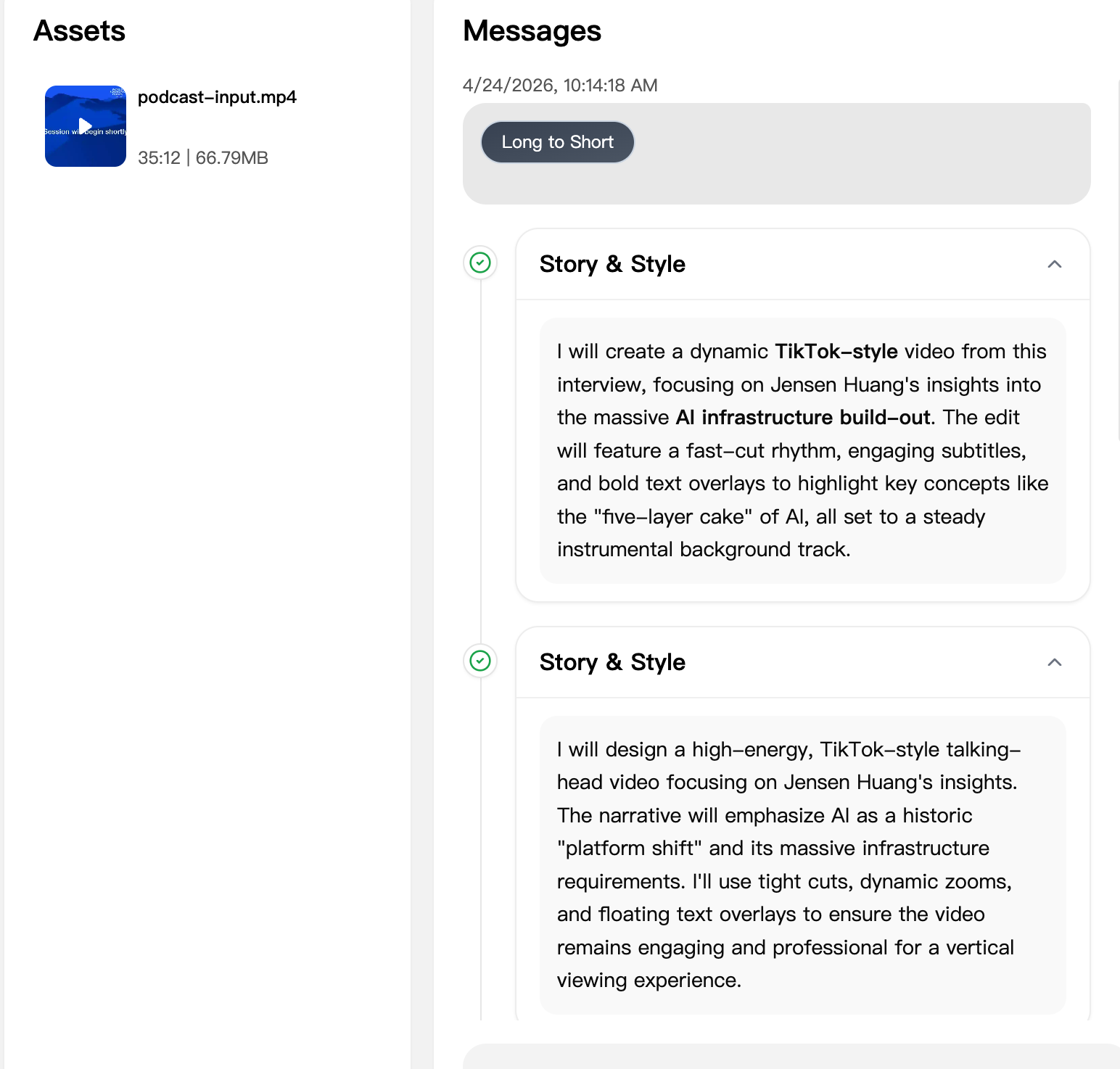
A short-first workflow that defines the story, hook, key idea, and viewing format before editing begins.
This planning difference matters because a podcast short is not a smaller version of the full episode. It has to work for a cold viewer who has no prior context.When the tool starts from the full episode, the short can easily become a selected moment. When the tool starts from the short, it has a better chance of becoming a complete thought unit.The difference does not start with captions, zooms, or transitions. It starts with whether the workflow treats the clip as something to extract or something to design.
When Extraction Works, and When It Creates Rework
Extraction-first workflows are not wrong. They are just not universal.They work well when the source content already contains modular, self-contained moments. That can include direct Q&A answers, clear advice snippets, punchy one-liners, standalone stories, or podcasts built around short quotable segments.
In those cases, fast clipping can be genuinely efficient.But extraction becomes less reliable when the content is structure-dependent. That includes reasoning-heavy conversations, debates, layered business or technical discussions, callbacks, sarcasm, humor, and multi-speaker exchanges where sequence matters.
That is where creators often feel the hidden cost.The tool may find a promising moment quickly. But the creator still has to add the missing framing sentence, extend the opening, repair an abrupt start, remove awkward reaction beats, fix captions that distort the meaning, or rebuild the clip around the actual idea.This is why a workflow can feel fast at the beginning and slow in total. It is optimized for first-pass generation, not necessarily for publish-ready clarity.The key question is:Is this moment already a clip, or is it only part of a clip?
If the moment makes sense to someone cold, extraction is fine. If the moment only works because of the surrounding conversation, the real task is not extraction. It is reconstruction.
A Better Workflow for Podcast-to-Shorts
For structure-driven podcasts, a better workflow starts from the idea unit, not the timestamp.
Step 1: Identify the complete thought unit
Do not start by asking, "What is the best line?"Start by asking, "Where does the idea begin, develop, and resolve?"The best short is often built around the smallest part of the conversation that still makes sense on its own. That may be a question plus answer, a claim plus explanation, a disagreement plus response, or a setup plus punchline.
Step 2: Keep the framing sentence
Creators often cut the sentence that feels least exciting, even when it is doing the most structural work.The framing sentence may not feel viral on its own. But it may be the sentence that tells the viewer what the clip is about.Removing it can save three seconds and cost the clip its meaning.
Step 3: Trim repetition, not logic
Podcast dialogue usually contains filler words, repeated phrasing, soft restarts, and verbal loops. Those can usually be removed.The dangerous cuts are the ones that remove the reasoning chain.A clip should move faster after editing, but the logic should still feel intact.
Step 4: Build for the cold viewer
The benchmark is not, "Would this make sense to me, knowing the episode?"The benchmark is, "Would this make sense to someone who lands on it with no prior context?"A short needs to answer quickly:
-
What is this about?
-
Why should I care?
-
What idea is being developed?
-
What is the payoff?
If the clip cannot answer those questions without the full episode, it needs more structure.
Step 5: Use captions to clarify the idea
Captions, lower-thirds, zooms, and text overlays should support comprehension.For podcast shorts, visual treatment should help the viewer follow the thought. Captions can carry the topic, clarify the premise, or emphasize the turn in the argument.
The goal is not simply to make the clip more dynamic. The goal is to make the idea easier to follow.
Where Structure-Aware Tools Fit
This is where planning-first or structure-aware tools become useful.Their value is not that they remove editorial judgment. They still need judgment. Their value is that they let the creator define the clip as a structured unit before the workflow locks into execution.
That can mean working from the transcript, planning by idea, assembling from multiple nearby moments, or using a tool like Sparki to describe the shape of the short before editing begins.This matters most when the clip depends on setup, sequence, or reasoning. It matters less when the source content is already modular.
The distinction is important. Not every podcast needs a heavier workflow. But many creators use extraction on content that clearly needs structure, then spend extra time fixing a mismatch that started earlier.
The Bottom Line
Podcast shorts fail less often because the wrong line was chosen. They fail because the right line was treated as a complete short when it was only the payoff.
That is the real editorial mistake.
For modular content, extraction is a practical workflow. Use it.For conversation-heavy podcasts, the better workflow starts earlier. Find the complete thought unit. Keep the framing context. Trim repetition without cutting logic. Build the short for a cold viewer.
The choice is not really between AI and manual editing. It is between two workflows:
-
find a moment and hope it stands alone
-
design a short that makes sense on its own
Most tools do not fail at editing. They fail earlier, by assuming the clip already exists.For podcasts, that difference matters more than most tool comparisons admit.
A podcast clip can sound excellent inside the full episode and still fail as a standalone short. The line is still there. The guest still sounds sharp. The laugh still lands. But once the moment is removed from the conversation that produced it, something breaks. The clip feels abrupt. The meaning gets thinner. A listener who never heard the surrounding discussion does not know why the moment matters.
That is the real failure mode in podcast repurposing. Most clipping workflows are built to find interesting moments quickly. They scan for spikes: laughter, emphasis, interruption, applause, changes in pacing, sometimes transcript keywords that look promising. That works when the moment is already self-contained. It works much less reliably when the value of the moment depends on what came before. And that is the issue with a large share of podcast content. Podcasts are not highlight reels by default. They are conversations. A useful conversation has setup, reasoning, reaction, tension, and payoff. Remove the wrong part, and the clip stops feeling complete. The problem is usually not that the tool is broken. It is that the workflow assumes every strong line is already a complete short.
A Podcast Clip Needs More Than a Peak
When creators say, "That would make a great short," they are often reacting to more than the sentence itself. They may be reacting to:
-
a question that made the answer surprising
-
a setup that made the joke land
-
a disagreement that created tension
-
a callback to something said earlier
-
a reasoning chain that made the conclusion persuasive
Extraction-first workflows are not really designed around those things. They are designed around detectable signals. They find moments that look important. They do not reliably judge whether the moment is structurally complete.
That distinction matters.
A clip can be engaging in the original episode because the audience already has context. The same clip can feel weak in isolation because the audience now lacks the setup that made the moment meaningful. This is why podcast shorts often end up in a strange middle state. They are not bad enough to discard immediately, but they are not ready to publish either. The creator adds a caption to explain the premise. Or adds a few seconds at the beginning. Or cuts around the line to restore context. Or reorders the segment so it makes sense to a cold viewer.
That is not a small polishing task. That is editorial reconstruction.
What "Context" Actually Means in a Podcast Clip
In this workflow, context is not filler. It is the minimum information required for the clip to make sense to someone who never heard the full episode. For podcast shorts, that usually means some combination of three elements.
1. Setup
What are they talking about? The setup gives the viewer a frame: the problem, the premise, the question, or the tension. Without it, the clip can sound like a fragment.
2. Reasoning or Reaction
Why does the point matter? This is where the clip earns its weight. A host clarifies the idea. A guest expands it. A cohost reacts. The viewer understands not just the statement, but the logic behind it.
3. Payoff
What is the moment the clip is actually trying to deliver? This could be the insight, the surprising line, the joke, the reversal, or the memorable phrasing. But payoff without setup usually feels thinner than creators expect. A useful way to think about this is simple: a strong podcast short is not just a "good line." It is a complete thought unit.
The Hidden Podcast Problem: AI Also Breaks Conversational Rhythm
Podcast clipping does not fail only because setup gets removed. It also fails because conversation has rhythm, and automated workflows often misread that rhythm. In multi-speaker shows, the system may treat the wrong thing as the active moment. A quick "yeah," a short laugh, a cohost reaction, or an overlap between speakers can get interpreted as a meaningful switch. That creates clips that feel unstable even when the underlying quote is good.
This is one reason podcast repurposing can feel more frustrating than creators expect. The clip is not only missing context. It may also feel visually or rhythmically off:
-
the framing changes at the wrong moment
-
a reaction gets treated like the main beat
-
the answer is present, but the question is gone
-
the agreement noise survives, but the reasoning does not
-
the segment starts just after the sentence that would have made it make sense
In other words, the clip can be technically active while still feeling editorially wrong. That matters because podcasts are often valuable precisely for their conversational flow. The intelligence of the moment is distributed across the exchange, not concentrated in one sentence.
Why Podcast Shorts Often Sound Incomplete
Podcast content creates a specific structural problem for AI clipping and fast repurposing workflows. Many valuable moments are not self-contained. They rely on what the host asked, what the guest explained, or how the conversation developed. A line that feels sharp at minute 34 may depend on a premise established at minute 31. A joke may depend on an earlier callback. A strong answer may only work because the question narrowed the meaning.
That is why podcast clips often fail in predictable ways:
-
the answer is present, but the question is gone
-
the conclusion is present, but the reasoning is missing
-
the reaction is present, but the premise is unclear
-
the joke is present, but the setup is absent
-
the clip contains energy, but not enough meaning
This is also why some clips feel technically correct but still underperform. The waveform looked interesting. The quote looked sharp. The system found a "moment." But the audience is seeing the moment without the structure that made it compelling. A recurring mistake in podcast repurposing is assuming that the loudest or sharpest line is automatically the most portable line. In practice, many of the best podcast moments are relational. They depend on timing, contrast, or buildup. Extract the surface moment without the supporting structure, and the value thins out immediately.
Where the Rework Actually Comes From
Creators often say an AI clipping workflow "mostly works" and still feel strangely tired by it. The reason is that the work has not disappeared. It has moved. Instead of spending time finding the moment, the creator spends time fixing the consequences of how the moment was extracted.
That rework often looks like:
-
adding the missing framing sentence
-
extending the opening so the quote has context
-
repairing abrupt starts or dead-stop endings
-
correcting captions that distort the meaning
-
removing awkward reaction beats that break the rhythm
-
rebuilding the clip around the actual idea rather than the detected spike
This is why a workflow can feel fast at the beginning and slow in total. It is optimized for first-pass generation, not necessarily for publish-ready clarity. A useful way to describe this shift is simple: creators stop feeling like editors and start feeling like QA technicians. They are no longer shaping the short from scratch. They are auditing what the system produced and fixing everything that still prevents the clip from standing on its own.
The Workflow Assumption Starts Before the Cut
The difference often appears before any cut is made.In a traditional editing workflow, the system usually prepares the full episode first. It transcribes the video, removes filler words, labels speakers, inserts chapters, improves audio, adds captions, and then asks whether social clips or audiograms should be created afterward.
That workflow is useful for cleaning and publishing a full podcast episode. But it also reveals a hidden assumption: the short clip is treated as a downstream output.
The episode is the main object. The short is something extracted later.For podcast shorts, that assumption can create rework. By the time the clip is generated, the structure has already been fixed around the full episode rather than around the standalone short.
A structure-aware workflow starts from a different question: what should this short actually communicate?Before editing, it defines the story, the hook, the key idea, the necessary context, and the viewing format. The clip is planned as a self-contained unit before the system locks into execution.This is why two tools can produce very different results from the same source video. The difference does not start with captions, zooms, or transitions. It starts with whether the workflow treats the clip as something to extract or something to design.
When Extraction Works, and When It Creates Rework
Extraction-first workflows are not wrong. They are just not universal. They work well when the source content already contains modular, self-contained moments. That can include:
-
punchy one-liners
-
clear advice snippets
-
direct Q&A answers
-
discrete stories with a natural beginning and end
-
podcasts built around short, quotable segments
In those cases, fast clipping can be genuinely efficient. But extraction becomes much less reliable when the content is structure-dependent. That includes:
-
reasoning-heavy conversations
-
debate or disagreement
-
layered business or technical discussion
-
callbacks and recurring themes
-
sarcasm or humor that needs setup
-
multi-speaker exchanges where the sequence matters
In those cases, creators often mistake rework for "normal polishing," when in fact the workflow is doing the wrong job first and the right job later.
The Better Question: Is This Moment a Clip, or Part of a Clip?
This is the question many teams skip. A strong line does not automatically equal a strong short. Sometimes the line is the clip. Sometimes it is only the payoff of the clip. That is the workflow decision that matters most.
Before clipping a podcast episode, it helps to ask:
-
Does this moment make sense to someone cold?
-
Does the viewer need the question first?
-
Does the viewer need one sentence of setup?
-
Does the insight depend on earlier reasoning?
-
Is the emotional value in the line itself, or in the build-up to it?
If the line already works alone, extraction is fine. If the line only works because of the surrounding conversation, then the real task is not extraction. It is reconstruction.
A Better Workflow for Podcast-to-Shorts
For structure-driven podcasts, a better workflow usually starts from the idea unit, not the timestamp.
Step 1: Identify the complete thought unit
Instead of asking, "What 45-second segment should I extract?" ask, "What is the smallest unit of this conversation that still makes sense on its own?" That might be:
-
a question plus answer
-
a claim plus explanation
-
a disagreement plus response
-
a setup plus punchline
Step 2: Keep the framing sentence
Creators often cut the sentence that feels least exciting, even when it is doing the most structural work. The line that frames the problem may not feel viral on its own. But it may be the sentence that lets the viewer understand the rest.
Step 3: Trim repetition, not logic
Podcast dialogue usually contains filler, repeated phrasing, verbal loops, and soft restarts. Those are easy to remove.The dangerous cuts are the ones that remove the logic chain.
Step 4: Build for the cold viewer
The benchmark is not, "Would this make sense to me, knowing the episode?" The benchmark is, "Would this make sense to someone who lands on it with no prior context?"
Step 5: Use captions and framing intentionally
Captions do not need to function as decoration. They can help carry setup, clarify the topic, or sharpen the viewer's understanding of the premise. That is still part of structure.
An Example: Same Moment, Different Outcome
To make this more concrete, I tested the same podcast source with different workflows before looking at the final edits.The useful signal was not only the finished clip. It was the plan each tool created before editing.One workflow focused on preparing the full episode first: transcription, speaker labels, chapter markers, captions, audio cleanup, and layout treatment. Social clips appeared as a later step.
Another workflow started by defining the short directly: the topic, the narrative angle, the viewer hook, the key idea to emphasize, and the vertical viewing experience.That planning difference matters because a podcast short is not just a smaller version of the full episode. It has to work for a cold viewer who has no prior context.
When the tool starts from the full episode, the short can easily become a selected moment. When the tool starts from the short, it has a better chance of becoming a complete thought unit.
A Practical Decision Framework
Before choosing a tool or workflow, ask three questions.
1. Is your podcast modular or structure-driven?
If the episode naturally contains self-contained moments, extraction can work well. If the value comes from reasoning, buildup, reaction, or context, planning-first editing is more reliable.
2. Are you optimizing for clip volume or clip coherence?
If the goal is a large number of usable first-pass clips, extraction may be enough. If the goal is fewer, stronger clips that work cleanly as standalone pieces, structure-aware editing is usually a better fit.
3. Is your real bottleneck moment-finding or rework?
Some creators struggle to find moments. Others find moments quickly and then lose time fixing incomplete clips. If rework is the real bottleneck, the answer is often not a faster extractor. It is a workflow that thinks about structure earlier.
Where Structure-Aware Tools Fit
This is the place where planning-first or structure-aware tools become useful. The value is not that they magically remove editorial judgment. They do not. The value is that they let the creator define the clip as a structured unit before the workflow locks into a cut. That can mean working from transcript, planning by idea, assembling from multiple nearby moments, or using a tool like Sparki to describe the shape of the short before execution. That matters most when the clip depends on setup, sequence, or reasoning. It matters less when the source content is already modular. That distinction is important. Not every podcast needs a heavier workflow. But many creators use extraction on content that clearly needs structure, then blame the tool for a mismatch that started earlier.
The Bottom Line
Podcast shorts fail less often because the wrong line was chosen than because the right line was treated like a complete short when it was only the payoff. That is the real editorial mistake. If your content is already built from standalone moments, extraction is a practical workflow. Use it. If your content depends on setup, reasoning, callbacks, or multi-speaker exchange, the better move is usually to build the clip as a complete thought unit from the start.
The choice is not really between "AI" and "manual." It is between two workflows:
-
find a moment and hope it stands alone
-
design a short that makes sense on its own
Most tools do not fail at editing. They fail earlier, by assuming the clip already exists.For podcasts, that difference matters more than most tool comparisons admit.
https://sparki.io/blog/podcast-to-shorts-without-losing-context