
Gemini 3 Pro for Video Editing: What the Model Actually Changes (and What It Doesn't)
Gemini 3 Pro cannot edit video itself. But its verified launch capabilities — 87.6% Video-MMMU, a million-token context, first-place long-horizon agentic planning — change what an AI video editor can understand and plan. Here is the official record, separated from inference, and what it means for editing tools.

Gemini 3 Pro does not edit video. Google's announcement on November 18, 2025 shipped no timeline, no export settings, and no feature called editing — the launch's closest gestures to creative work were multimodal understanding and an agentic IDE. Search for the model's name next to "video editing," though, and you would think it was a Premiere competitor. What is actually true is narrower and more interesting: Gemini 3 Pro changed the raw material an AI video editor is built from — how much of your footage a model can genuinely understand, how long a plan it can hold, and how much project context survives from your first instruction to the final cut.
This article separates the three layers that usually get mashed together in "AI model X for video editing" coverage: what Google verifiably shipped, what those capabilities plausibly mean for editing (flagged as our inference wherever it is), and what stays unchanged no matter how good the model gets. It is the model-level companion to our map of AI video editing paradigms and to the route-by-route guide on editing video with Claude — the paradigm view and the orchestration view, respectively. Facts about the model below are checked against Google's official launch materials as of this October 2026 update, and dated accordingly.
What Google Actually Shipped
The official record first. Gemini 3 Pro was announced by Google on November 18, 2025 and released in preview, alongside a Deep Think variant flagged for Ultra subscribers later. Google positioned it as its strongest model yet for multimodal understanding across text, images, video, audio, and code, with a one-million-token context window. Among the launch benchmarks Google itself published: 81% on MMMU-Pro (multimodal reasoning), 87.6% on Video-MMMU (acquiring and using knowledge from video), 72.1% on SimpleQA Verified (factuality), 91.9% on GPQA Diamond (scientific reasoning), 76.2% on SWE-bench Verified (agentic coding), a first place on Vending-Bench 2 — a benchmark built around long-horizon planning — and the top of LMArena at 1501 Elo at launch.
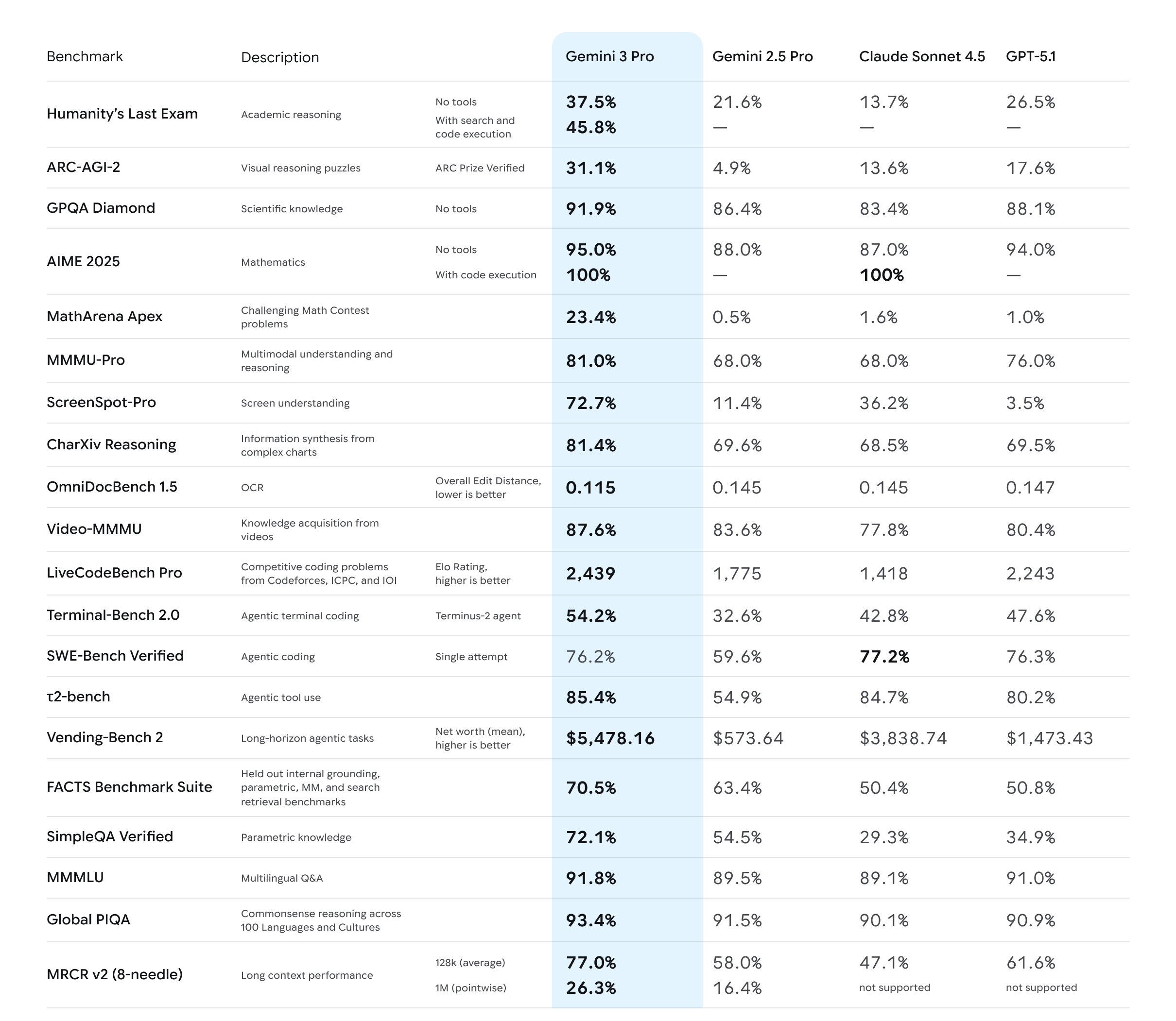
A launch-window benchmark compilation comparing Gemini 3 Pro with Gemini 2.5 Pro, Claude Sonnet 4.5, and GPT-5.1. The figures Google published on November 18, 2025 include the MMMU-Pro, Video-MMMU, SimpleQA Verified, and GPQA Diamond numbers above; the long-context (MRCR) and math (AIME 2025) columns in such charts come from third-party compilations of launch-window data, not from Google's announcement post itself. Treat those as directional.
Two honesty notes belong next to those numbers. First, they are launch-window figures, and the leaderboard has moved since: Google shipped a successor, Gemini 3.1 Pro, in 2026 (its DeepMind model card is dated February 19, 2026), and every frontier vendor has kept iterating. Second, none of these benchmarks measures editing. Video-MMMU tests whether a model can acquire knowledge from a video, which is a prerequisite for editing intelligence, not evidence of it. The numbers matter because they mark the capability jump from the 2.5 generation — the jump that made model-driven editing plausible rather than hypothetical.
Why Editing Cared in the First Place
When we analyzed 1,015 user reviews in late 2025, three failure patterns dominated: export and delivery fragility, cognitive overload as projects grow, and workflow fragmentation — too many tools and steps between the footage and the publishable cut. The full method and numbers are in the AI video editor paradigms report; the pattern that matters here is that all three share one root cause the timeline paradigm cannot fix. The software does not understand the content. Structure, semantics, and intent are injected by a human, one decision, one track, one keyframe at a time.
That is why a frontier multimodal model is relevant to editing at all. It is not another AI feature bolted onto a timeline; it is the missing comprehension layer. Three of its capability areas map directly onto those failure modes — and the mapping below is our editorial analysis, not a Google claim.
Long-Horizon Reasoning Turns Editing From Effects Into Plans
Complex editing has always been a reasoning problem more than a cutting problem. A good editor interprets intent, decides which moments matter, reshapes the narrative arc, manages pacing across segments, and keeps tone coherent over a long runtime. Earlier model generations could not hold that chain of decisions together — they operated clip by clip and prompt by prompt, losing the big picture a few steps in.
The official anchor for believing this generation is different: Google reported Gemini 3 Pro in first place on Vending-Bench 2, a benchmark specifically designed around sustained, long-horizon planning, and described it as its best agentic model to date. The reasonable inference — ours, not Google's — is that a model which can keep a plan coherent across a very long task can also keep an edit plan coherent: why a sequence exists, how each beat serves it, and which changes would break the logic. In an editing system built to exploit that, long-form output starts to feel composed rather than stitched from isolated highlights, and suggestions stop "missing the point" of the brief. That is a system property, though, and it only appears if the editing tool is architected to plan rather than to trigger one-shot effects.
Multimodal Understanding Makes Semantic Errors a Comprehension Problem You Can Win
Most "AI editing" failures are misunderstandings, not mechanical faults. Subtitles drift from what was said, music clashes with a scene's emotional register, the narrative thread breaks in talking-head and interview formats, speakers get confused in multi-person footage, and B-roll picks feel arbitrary. These are not UX problems; they are comprehension problems, and no amount of timeline polish fixes them if the system cannot tell what is being said, who is speaking, and how the scene feels.
Here the official record is directly on point: Gemini 3 Pro's video-understanding score (87.6% on Video-MMMU) and multimodal reasoning score (81% on MMMU-Pro) were the headline numbers of Google's launch post, positioned as state of the art at release. Again, our inference: a model that reads text, image, audio, and video jointly can anchor an editing system's judgment — catching emotional transitions rather than keywords, tracking speaker turns, keeping scene continuity in view. The downstream effects an editor would actually feel are fewer "why did it pick that?" moments, captions and chapters that match what was said, and key-moment detection that survives formats beyond the single talking head. If you want to see that principle applied end to end, our walkthrough of editing YouTube videos with an AI agent shows meaning, not timestamps, driving the cut.
The Million-Token Context — the Honest Version
Real projects do not arrive as neat 30-second clips. A single production can span hours of raw footage, transcripts, scripts, brand guidelines, reference videos, and scattered non-negotiables. Earlier generations dropped constraints, lost threads, and drifted from the brief as material piled up — which is exactly when the review analysis showed creators giving up on AI assistance.
The verified fact: Gemini 3 Pro's context window is one million tokens, per Google's launch announcement. The honest caveat that most coverage skips: video consumes tokens far faster than text, so a million tokens does not literally hold every frame of a multi-hour shoot plus all your documents. What it can realistically hold is the text-heavy spine of a project — transcripts, the brief, brand rules, notes — alongside substantial stretches of footage, so early and late sections stay aligned on message without constant re-briefing. That is a genuine change from the era of short-context models, and it is what makes whole-project coherence a design goal rather than a fantasy. For the workflow this most affects — carving coherent shorts from a long source — see our piece on long-to-short video editing.
What the Model Still Doesn't Change
No matter how strong the model, it edits nothing by itself. It has no concept of a render queue, an export preset, or a project file; someone has to build the system around it. That distinction explains why "we call Gemini via API" on an existing timeline tool changes so little — comprehension bolted onto an operations-first interface still leaves the creator as the glue, the exact failure the paradigm report documented across every established tool type. The architecture question (who plans, who executes, who reviews) matters as much as the model question, which is why the automation boundary we drew in what AI video editors can and can't automate cuts across every model choice.
The other unchanged thing is judgment. A model can understand footage deeply and still make pacing calls you would reject — and the boundary between mechanical passes that hand over cleanly (silence trims, captions, rough assembly) and taste calls that need you holds regardless of which frontier model is underneath. Stronger models move the line of what drafts well; they do not delete the review loop.
Where Sparki Fits — With Our Cards on the Table
Full disclosure: Sparki — the product we build, at sparki.io — is an agentic editor in exactly this camp. You upload footage you already shot, brief it in plain language, and it plans and executes the edit, hands you a draft, and refines across conversation rounds. To be precise about claims on a model-analysis page: this article describes what a frontier multimodal model makes possible for editing systems in general. It is not a statement about which specific model runs inside any particular product, ours included — internal model selection is an implementation detail that changes faster than the underlying analysis, and we would rather you verify current capabilities on the product site than take a blog post's word for it.
What we will claim is architectural, and it follows from everything above: an editor designed around comprehension — brief in, plan out, draft for review — can absorb capabilities of this model class in a way an operations-first timeline cannot. Sparki's honest boundaries are the field's boundaries: it works on existing footage rather than generating new video, and its drafts are for your review, not frame-perfect final cuts on autopilot. The understanding is strong and getting stronger; the review loop stays yours.
https://sparki.io/blog/gemini-3-pro-ai-video-editor