
How to Master Hyper-Realistic Illusion Content Like AmauryGuichonChef
Learn Amaury Guichon’s viral hyper-realistic chocolate illusion content formula. Master nostalgic object selection, texture replication, macro cinematography, beat-synced editing and silent bite reveal tricks to create high-view short videos replicable on Sparki.

Creator Spotlight: Amaury Guichon yong(23.4 million subscribers)
Amaury Guichon is not a food creator — he is an illusionist who works in chocolate. With 23.4 million followers, the French-Swiss pastry chef has built an entirely distinct content category: hyper-realistic edible sculpture , where the final product is indistinguishable from the real object until someone takes a bite.His content model is built on a single, powerful premise: the viewer knows this is chocolate, and still cannot believe it. That cognitive dissonance — knowing something is food while being unable to perceive it as food — creates a neurological loop that is almost impossible to break without watching until the very end. Every video is a sustained exercise in disbelief, and the "bite reveal" at the end is one of the most reliable viral mechanics in short-form food content.What separates Guichon from other skilled pastry creators is his film school-quality production: clinical studio lighting, macro cinematography, beat-synced editing, and sound design that replaces music with ambient tool sounds at precisely the right moments. He doesn't just document his craft — he directs it.
Video Example
Video URL:https://www.youtube.com/shorts/rj60H_Y3bQ8
Creator: Amaury Guichon (@AmauryGuichonChef)
Published: 2026-06-09
Duration: 60 seconds
Video Stats: Views: 10,274,877 | Likes: 206,599 | Comments: 1,100
Copy link
Why This is a "Must-Copy" Style
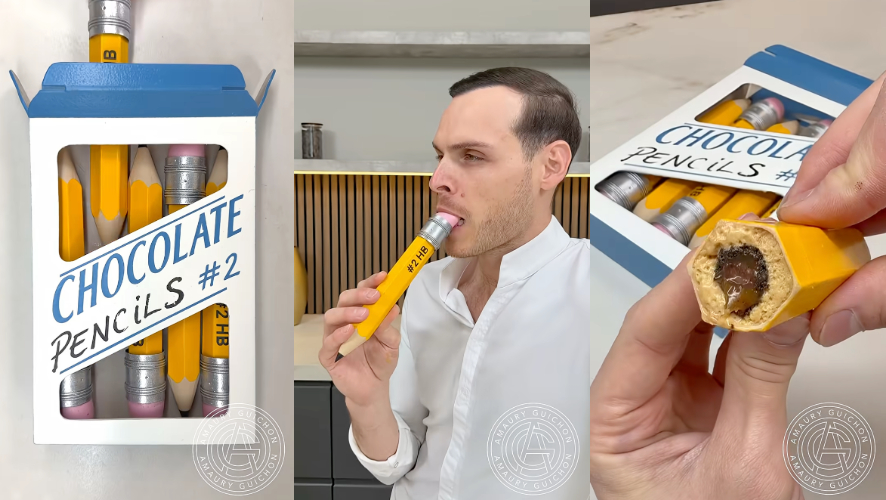
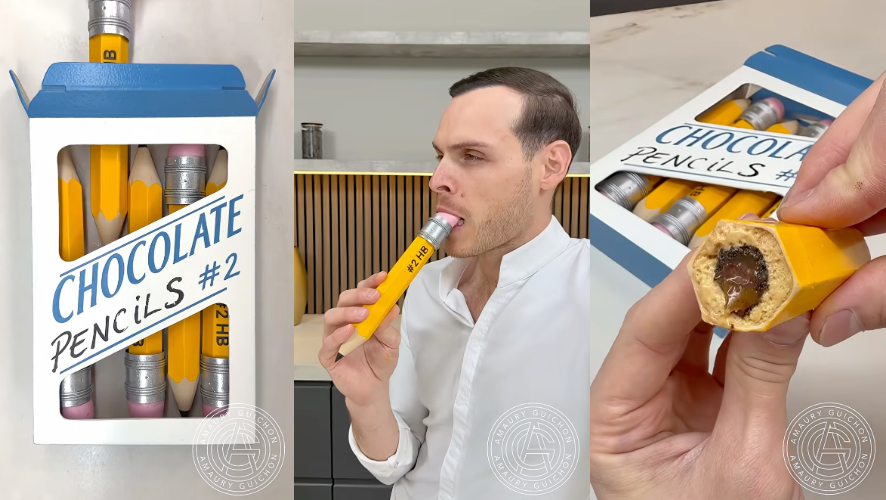
This video succeeds on two simultaneous levels that are rarely combined: craftsmanship porn and nostalgia bait. The pencil is the single most universally recognizable object of childhood — every viewer on earth has held one, sharpened one, chewed one. When Guichon recreates it in chocolate with millimeter-level accuracy, the emotional response is not just "wow, that's impressive" but something closer to wonder : the feeling of seeing something familiar made impossible.The second mechanism is the "I know but I can't believe it" loop. From the first frame, the viewer knows this is a chocolate video. They know the pencil is made of food. And yet every subsequent shot — the wood-texture shaving curls, the metallic ferrule, the pink eraser speckle — keeps triggering the involuntary response: that looks exactly real. This sustained dissonance is what drives the 10 million views. The viewer stays until the bite because they need the final proof that what they're watching is actually edible.
Try Now
1. Core Structure (Video Narrative Arc)
The video follows a strict "Component → Assembly → Proof" arc — the same structure used in every great magic trick: show the materials, build the illusion, then prove it.
The Eraser Foundation (0–7s)
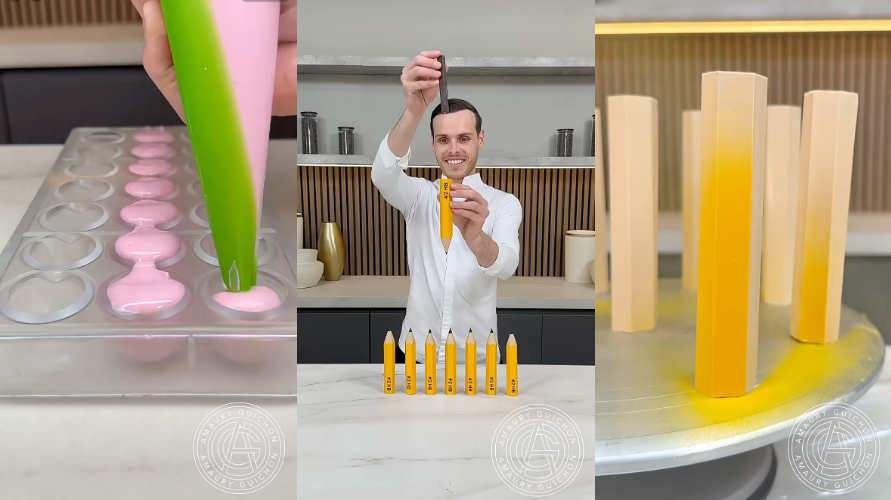
The video opens with vivid pink and green chocolate being piped into a mold — pure color and texture stimulus with no explanation. The viewer doesn't yet know what's being made. This uncertainty is the first open loop: what is that going to become?Editing technique: Open with the most visually striking material moment, not the finished product. The mystery of "what is this?" is more compelling than the answer — the same open-loop retention trick documented in the satisfying prank format breakdown. Guichon never shows the pencil concept until the viewer has already been hooked by color and precision.
Structural Engineering (8–20s)
The yellow chocolate body is introduced at scale — now the viewer begins to guess: a pencil? The sharpening sequence at 17s is the video's primary visual climax. A real sharpener. Real wood-like curls spiraling off a chocolate cylinder. This is the moment that gets screenshot and shared — the most "impossible" visual in the entire video.Editing technique: Place your single most "impossible" shot at roughly the one-third mark (17s of 60s). This keeps the viewer watching through the first act and converts casual scrollers into committed viewers who need to see how this ends.
The Detail Phase (21–39s)
The "leads" are extruded from dark chocolate through tiny piping nozzles. The ferrule rings are sculpted, then sprayed with silver edible metallic paint that renders them visually identical to real aluminum. Each component gets its own 2–3 second macro close-up.Editing technique: The detail phase is where most food creators rush. Guichon slows down here — lingering on each material transformation because the detail is the point, and pacing decisions like slow-here/fast-there are exactly what an AI video editor can rough out before you make the final calls. Every extra second spent on the silver spray, the graphite lead, the eraser speckle adds another increment of disbelief that compounds into the final reveal.
The Playful Proof (40–60s)
The assembled pencils are placed in a real pencil box. The creator uses one to actually draw a line on paper — it works. Then uses the eraser — it erases. Then takes a bite: caramel interior, chocolate shell, a clean cross-section showing every layer. The music drops slightly for the bite sound. The illusion is complete.Editing technique: The functional proof sequence (draw → erase → bite) is a three-beat resolution that answers every question the video has raised. The sound design choice — letting the bite sound be heard clearly over the music — is the most important audio decision in the entire video.
2. The Hyper-Realism Formula
Object Selection: The Nostalgia Multiplier
Guichon's choice of subject matter is never random. He consistently selects objects that have universal recognition and childhood association : pencils, basketballs, Lego bricks, cameras. The reason is simple: the more deeply familiar the object, the more powerful the dissonance when it's revealed as chocolate. A hyper-realistic version of an obscure object would only impress people who know that object. A pencil impresses every human alive.Key rule: For illusion content, choose your subject object by asking: does every person on earth aged 5–80 immediately recognize this? If yes, it has maximum viral potential. If no, reconsider.
Texture Replication as the Core Skill
The video's technical achievement is not the assembly — it's the texture matching. Each element of the pencil requires a different surface treatment:
-
Pink eraser : speckled texture achieved through a specific chocolate compound
-
Wood body : smooth exterior with visible grain lines scored into the chocolate
-
Wood shavings : real curl texture produced by actual sharpening
-
Graphite lead : dark chocolate extruded at exactly the right diameter
-
Metal ferrule : silver edible metallic spray over textured chocolate rings
The viewer's brain identifies these textures at a pre-conscious level. Even before they consciously think "that looks like real wood," their visual cortex has already registered the grain pattern as wood. This subconscious confirmation is what makes the illusion work at scale — it doesn't require the viewer to examine it closely. It reads correctly from a distance, on a phone screen.Key rule: In any illusion or transformation content, the texture must be correct before the color. Humans identify materials by texture first, color second. Get the surface right and the color can be approximate.
3. Production: Lighting, Macro, and Sound Design
Clinical Studio Lighting
Every Guichon video is shot in the same controlled studio environment: white surfaces, high-key overhead lighting, zero shadows on the work surface. This serves a dual purpose. First, it makes the colors of the chocolate — the vivid pinks, the saturated yellows, the metallic silvers — pop against the neutral background. Second, it signals professional expertise. The clinical environment says: this is not a home kitchen, this is an atelier.Key rule: If you're filming precision craft content, eliminate all ambient shadows on your work surface. Shadows are the enemy of texture visibility. High-key, diffused overhead light (softboxes, not direct studio flash) is the standard.
Macro Cinematography as the Trust Engine
The camera is almost always within 15–30cm of the subject. This proximity means the viewer sees details they could not see in person — the individual sparkle of the metallic spray, the precise extrusion of the chocolate lead, the exact moment the sharpening curl separates from the pencil body. This hyper-close perspective builds trust in the illusion: if it can withstand macro scrutiny, it must be real.Key rule: Film your most technically impressive detail at the closest distance your lens allows. If the detail holds up at macro, it will look astonishing at full-screen viewing distance.
The Music-to-Silence Transition
"School's Out" plays throughout the video — fast, energetic, beat-synced cuts. But at 58 seconds, when the creator takes the bite, the music drops to near-silence. Just the crunch. This is the most important sound design choice in the video. After 58 seconds of music, silence registers as an event. The viewer's attention spikes. The bite sound — the final sensory proof — arrives in silence and lands harder because of it.Key rule: In any reveal video, drop your background music to near-zero for the final payoff moment. The contrast between sustained music and sudden quiet signals: this is the moment. The viewer's brain sharpens its focus automatically.
4. The Beat-Synced Edit
Throughout the construction phase, every major cut lands on a guitar riff or drum beat from the "School's Out" cover. This is not casual editing — it requires mapping the music first and then building the cut sequence around the beats.The result is that the process feels fast and effortless even though the viewer can see the technical complexity of each step. The rhythm of the music gives the viewer permission to trust that the creator has this under control — the cuts say "we're moving at speed because we know exactly what we're doing."Key rule: For craft content, edit to a track with a strong, consistent beat. Map your cut points to the beat before you place footage. A process that takes 3 hours should feel like a confident 60 seconds.
How to Replicate
| What to Replicate | Reference Video | How Sparki Replicate |
|---|---|---|
| Universal Nostalgia Object | Pencil — recognized by every human on earth, associated with childhood school memories | Replicate by choosing a subject with maximum universal recognition (basketball, LEGO, ruler, tennis ball) — avoid niche objects |
| Mystery-First Opening | Pink and green chocolate piped into mold (0–7s) — no explanation, no title card, just texture and color | Replicate by opening with your most visually striking material moment before the viewer knows what's being made |
| The Impossible Shot at 1/3 Mark | Sharpening sequence at 17s — real sharpener producing real-looking wood curls from chocolate | Replicate by placing your single most "impossible" visual at the 15–20s mark to convert scrollers into committed viewers |
| Texture-First Replication | Each element (eraser, wood, ferrule, lead) has a distinct surface treatment before color is applied | Replicate by solving texture first — surface grain, roughness, sheen — then address color; the brain reads texture before color |
| Clinical High-Key Lighting | White studio surfaces, high-key overhead lighting, zero work-surface shadows throughout | Replicate with two softbox lights at 45° angles above the work surface, eliminating all directional shadows |
| Macro Detail Phase | Silver spray on ferrule at 38s — camera within 20cm, metallic transformation visible frame by frame | Replicate your most technically precise step at macro distance; if it holds up at 20cm, it reads as real at full screen |
| Music-to-Silence Bite Reveal | "School's Out" drops to near-silence at 58s for the crunch sound of the final bite | Replicate by cutting background music to 5–10% volume for your final payoff moment — the silence signals "pay attention now" |
https://sparki.io/blog/how-to-master-hyper-realistic-illusion-content-like-amauryguichonchef