
The "Satisfying Prank" Format Like candy.superstar: A 42-Second Breakdown
A scene-by-scene analysis of Candy Superstar's satisfying-prank Short: its multi-hook re-engagement cadence, sensory color design, cliffhanger open loops, milestone-gamified CTAs, and how to adapt each technique to your own footage.

This breakdown is based on the Short embedded below (published June 29, 2026) and a scan of the channel's recent uploads around that date; all timestamps refer to that video.
Candy Superstar (@candy.superstar) is one of the clearest examples of a creator who has reverse-engineered the YouTube Shorts algorithm into a repeatable content system. With nearly 20 million subscribers at the time of writing, her formula is not accidental — it is a deliberately designed loop built to convert first-time viewers into subscribers within a single 42-second clip.Her signature format sits at the intersection of three content genres that rarely overlap: oddly satisfying visuals , couple pranks , and milestone gamification. Individually, each of these genres performs well. Combined in the right sequence, they create a video structure where every 5–8 seconds introduces a new reason to keep watching. This is not content creation — it's viewer psychology engineering.The visual identity is equally deliberate: high-saturation color palettes (neon blue, fire red), high-key lighting, and macro texture shots that trigger involuntary ASMR responses. Candy Superstar doesn't just make videos that look good — she makes videos that feel good to watch.
Video Example
Video URL:https://www.youtube.com/shorts/_K7Dyl3iuYg
Creator: Candy Superstar (@candy.superstar)
Published: 2026-06-29
Duration: 42 seconds
Video Stats (captured June 2026): Views: 1,904,275 | Likes: 53,314 | Comments: 224
Copy link
Why This Style Works
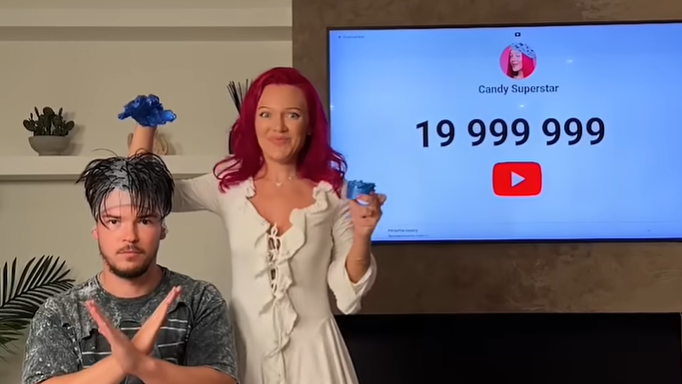
This video works because it never lets the viewer settle. From the first frame to the last, every 5–8 seconds introduces a new narrative element that re-engages anyone who is about to scroll away. This is called the "double-hook" structure : the first hook (the satisfying blue dye pour) captures attention; the second hook (the doorbell + mysterious package) maintains it; the third hook (the prank on the boyfriend) escalates it; the fourth hook (the live subscriber count) converts it.Most creators structure their videos with one hook at the start and then coast. Candy Superstar re-hooks every 8 seconds, so there is never a safe moment to leave — the structure is built to hold retention all the way to the end.The second mechanism: it gamifies the subscribe action. By showing a live subscriber count at 19,999,999 on a TV screen in the final seconds, she makes clicking "subscribe" feel like participating in a live event. The viewer isn't subscribing to a channel — they're pushing the counter over 20 million. That reframe does work no verbal call-to-action can.
Try Now
1. Core Structure (Video Narrative Arc)
The video runs four distinct "acts" in 42 seconds — roughly one act per 10 seconds — each with its own hook, climax, and transition into the next.
Act 1 — The Sensory Hook (0–4s)
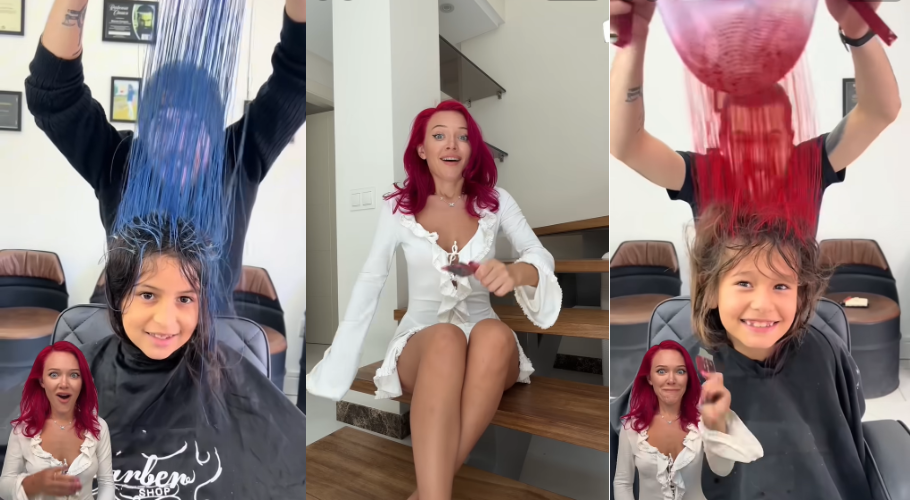
No introduction. No title card. The video opens at peak visual intensity: vibrant neon-blue hair dye being poured in a "curtain waterfall" effect, intercut with the finished blue result. This is pure sensory stimulus — the equivalent of a food video's "money shot" placed at the very start rather than the end, the same front-loaded spectacle that drives hyper-realistic illusion content.Editing technique: 3–4 rapid cuts in 4 seconds, all close-up or macro, all showing the same core visual (the dye) from different angles. The viewer hasn't been told a story yet — they've just been hit with dopamine. That's enough to stop the scroll.
Act 2 — The Narrative Pivot (5–14s)
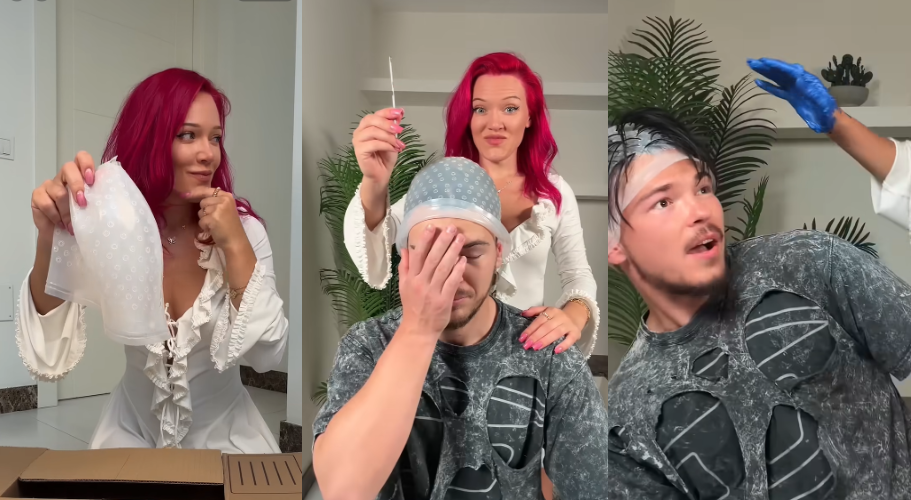
A doorbell sound cuts through the visual hook. The creator opens a package containing a highlighting cap — an unfamiliar tool that creates a "knowledge gap" in the viewer. What is that? What does it do? This is an open loop deliberately left unanswered for the next 15 seconds.Editing technique: The audio cue (doorbell) is the transition, not a visual cut. Sound-triggered transitions feel more organic than visual-only edits and prevent the "choppy" feeling that plagues fast-paced videos.
Act 3 — The Prank Rising Action (15–28s)
The creator wakes up her boyfriend and begins pulling his hair through the tiny holes of the highlighting cap using a metal crochet hook. His grimacing reactions — somewhere between confusion, discomfort, and reluctant trust — provide the comedic tension. The macro shots of hair being pulled through the rubber cap are simultaneously satisfying and cringe-inducing: the exact emotional combination that generates comments.Editing technique: Alternating between macro detail shots (the cap, the hook, the hair) and reaction shots (his face) creates a rhythm of "process → response → process → response." This rhythm keeps the visual variety high without requiring scene changes, which would break the tension.
One boundary to keep in mind before adapting this act: the format only works when the person being pranked is in on it. Candy's boyfriend is a consenting, clearly willing participant whose reactions are played for shared comedy. Pranks filmed without the subject's consent cross from comedy into harassment, get reported and removed by platforms, and can end relationships — so treat consent as a production requirement, not an afterthought.
Act 4 — The Conversion Climax (29–42s)
The final act merges the prank with a live subscriber milestone: a TV screen showing 19,999,999 subscribers. The creator points at the screen, breaking the fourth wall directly. The unfinished hair result is never shown — the video ends on the cliffhanger, with the subscription count as the only resolution available to the viewer.Editing technique: The "to be continued" structure is intentional — it ensures that interested viewers either subscribe (to see Part 2 on the channel) or return to the channel page looking for the follow-up. Either action helps the algorithm.
2. The Multi-Hook Architecture
What "Double Hook" Actually Means
Most creators understand the concept of a hook (the first 3 seconds). Fewer understand that short-form videos need to re-hook every 8–10 seconds to maintain retention. The reason is simple: on a phone, the swipe gesture takes less than 0.5 seconds. Any moment of visual or narrative "flatness" is a swipe waiting to happen — comedy formats like Lilly Singh's viral skits survive the same way, on relentless re-hooks.Candy Superstar's solution is to treat every 8 seconds as a new video with its own hook:
-
0s : Visual sensory hook (dye pour)
-
5s : Narrative mystery hook (package + unknown tool)
-
15s : Emotional/humor hook (boyfriend prank)
-
29s : Gamification hook (live subscriber counter)
Key rule: Map your video in 8-second segments. Each segment needs either a new visual element, a new narrative question, or a new emotional tone. If any segment has none of these, cut it.
The Open Loop Technique
An "open loop" is an unanswered question deliberately planted in the viewer's mind. This video plants three:
-
What does the highlighting cap do? (planted at 8s, partially answered at 28s)
-
What will his hair look like when it's done? (planted at 15s, never answered — the cliffhanger)
-
Will she hit 20 million? (planted at 38s, answered only if you subscribe)
The more open loops a video contains, the harder it is for the viewer to leave without feeling unresolved. Psychologists call this the Zeigarnik Effect : humans have a stronger memory for and attention to unfinished tasks than completed ones.
3. Sensory Design: Color, Macro, and ASMR
High-Saturation Color as a Brand Signature
The neon blue of the hair dye and the fire red of the finished color are not coincidental choices. High-saturation primary colors are among the most scroll-stopping hues on mobile screens, which are typically viewed in bright ambient light. They also create an instantly recognizable visual signature — after seeing two or three Candy Superstar videos, the viewer can identify her content from the thumbnail alone.Key rule: Choose 1–2 signature colors for your content and use them consistently across every video. Your color palette is part of your brand identity, not just an aesthetic preference.
Macro Texture as ASMR Trigger
The close-up of hair being pulled through the tiny holes of the rubber cap — one strand at a time, with a metal hook — is a textbook ASMR visual. The precision, the texture, the repetitive motion: each element triggers an involuntary sensory response in the viewer. This is why the section at 15–28s holds retention despite being objectively uncomfortable to watch. The body is physiologically engaged even when the mind is "cringing."Key rule: For any process-based content (hair, food, crafts, skincare), include at least one macro texture sequence. The closer the camera, the more sensory the response.
High-Key Lighting as Energy Signal
Throughout the video, the lighting is bright, even, and shadow-free. This is not just aesthetic — high-key lighting signals energy, positivity, and high production value to viewers within milliseconds of the first frame. Dark or moody lighting in a lifestyle video sends the wrong emotional signal and reduces click-through rates on the thumbnail.
4. The Gamified Call-to-Action
Making "Subscribe" Feel Like Participation
The standard YouTube CTA is: "Subscribe for more content!" It is ignored almost universally because it asks the viewer to act for the creator's benefit. Candy Superstar inverts this by making the subscribe action feel like the viewer is completing something for themselves — specifically, pushing a counter over a milestone number.When the TV screen shows 19,999,999 subscribers and the creator points directly at the camera, the implicit message is: you are the 20 millionth subscriber. That framing is extraordinarily powerful. The viewer isn't subscribing to a channel — they're being invited to make history, even if only in a small way.Key rule: Tie your CTA to a specific, visual, time-sensitive milestone. A number on a screen that's one subscriber away from a round number is more powerful than any verbal request. Make the viewer feel like the deciding vote.
How to Apply It to Your Own Footage
The techniques below describe what happens in the reference video and how to translate each one to your own footage and subjects (with their consent).
| Technique | What Happens in the Reference Video | How to Apply It to Your Footage |
|---|---|---|
| Peak-First Hook | Neon blue "curtain pour" dye shot at 0s — no intro, no title, just the most visually extreme moment in the video | Open with your single most visually striking frame — the "money shot" moved to the first second |
| Sound-Triggered Scene Transition | Doorbell audio cue at 5s transitions from beauty hook to lifestyle narrative | Use a diegetic sound (bell, tap, pop) as the edit point between scenes instead of a visual cut |
| Multi-Hook Re-engagement | New narrative hook every 8–10s: dye → package → prank → subscriber counter | Script a new visual/narrative element at the 0s, 8s, 16s, 24s, and 32s marks before filming |
| Macro ASMR Texture | Hair pulled through rubber cap holes with metal hook at 15–28s — one strand at a time | Film any precision process at macro distance: individual eyelash application, piping details, ingredient prep |
| Reaction Shot Intercut | Boyfriend's grimacing face alternated with process macro shots throughout Act 3 | Cut a "process → reaction → process → reaction" rhythm when filming with a partner or subject |
| Gamified Live Counter CTA | TV screen showing 19,999,999 subscribers at 38s — one away from milestone | Display a visual milestone counter (subscribers, orders, followers) in the final 8 seconds and point directly at camera |
https://sparki.io/blog/how-to-master-the-satisfying-prank-format-like-candy-superstar