
Pamela Reif's '+7kg' Short: The Edit That Tells a Strength Story
A frame-by-frame editing analysis of Pamela Reif's 12-second "+7kg" YouTube Short: why it starts from an already-strong baseline, places one metric on the beat drop, uses equipment shots as proof, and never needs a before/after split screen.

Most fitness Shorts feed their audience a subtraction story: a "before," a "after," and a transformation measured downward. Pamela Reif's twelve-second Short runs the opposite claim — the on-screen text ends on "stronger +7kg" — and it still works inside the same feed. That reversal is not carried by the caption alone. It is built by a series of ordinary editing decisions: where the story starts, when the number appears, what the settings prove, and where the music turns. This article takes the Short apart at those joints.
What follows is an analysis of narrative structure and editing, not of anyone's body, and not fitness advice. Every claim below is anchored to a frame that was captured and timestamped when this analysis was first recorded in June 2026 — the frames sit inline as evidence, and the timestamps refer to them. The pattern worth taking is the edit structure, which transfers to your own footage and your own numbers; it does not include borrowing a creator's identity, footage, or story.
The sample, and what one Short can prove
The subject is a single YouTube Short, LXQdVK2D3yk on Pamela Reif's channel, roughly twelve seconds long. When this analysis was first recorded in June 2026, the Short showed about 558,000 views, 6,693 likes, and 123 comments, and Reif's channel listed around 10.7 million subscribers; all three figures are observations from that date, not live counts. One video proves nothing about a creator's long-term strategy — a dozen of her uploads would — but it is a complete, self-contained case of a narrative problem solved in editing: how to make a weight-gain claim land as progress in a feed calibrated for weight loss.
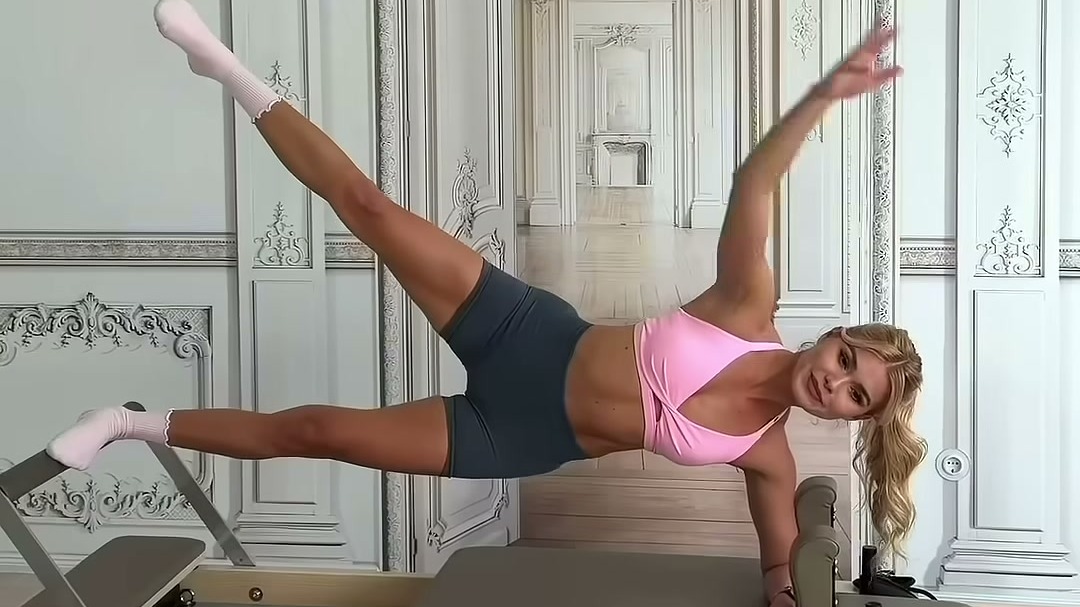
The edit's answer has three moves: start the story from an already-strong baseline, put the only number exactly on the music's turn, and let the locations escalate the claim. Each move survives being paused and inspected, which is what makes it worth studying.
Why the edit starts from an already-strong baseline
The Short opens not with a "before" but with self-documentation: mirror-selfie framing in a bathroom, shot in the register of a progress check-in rather than a performance. The frame captured at 0.1s shows the setup — phone-facing-mirror, private space, the visual vocabulary every fitness viewer recognizes as "tracking my own progress."
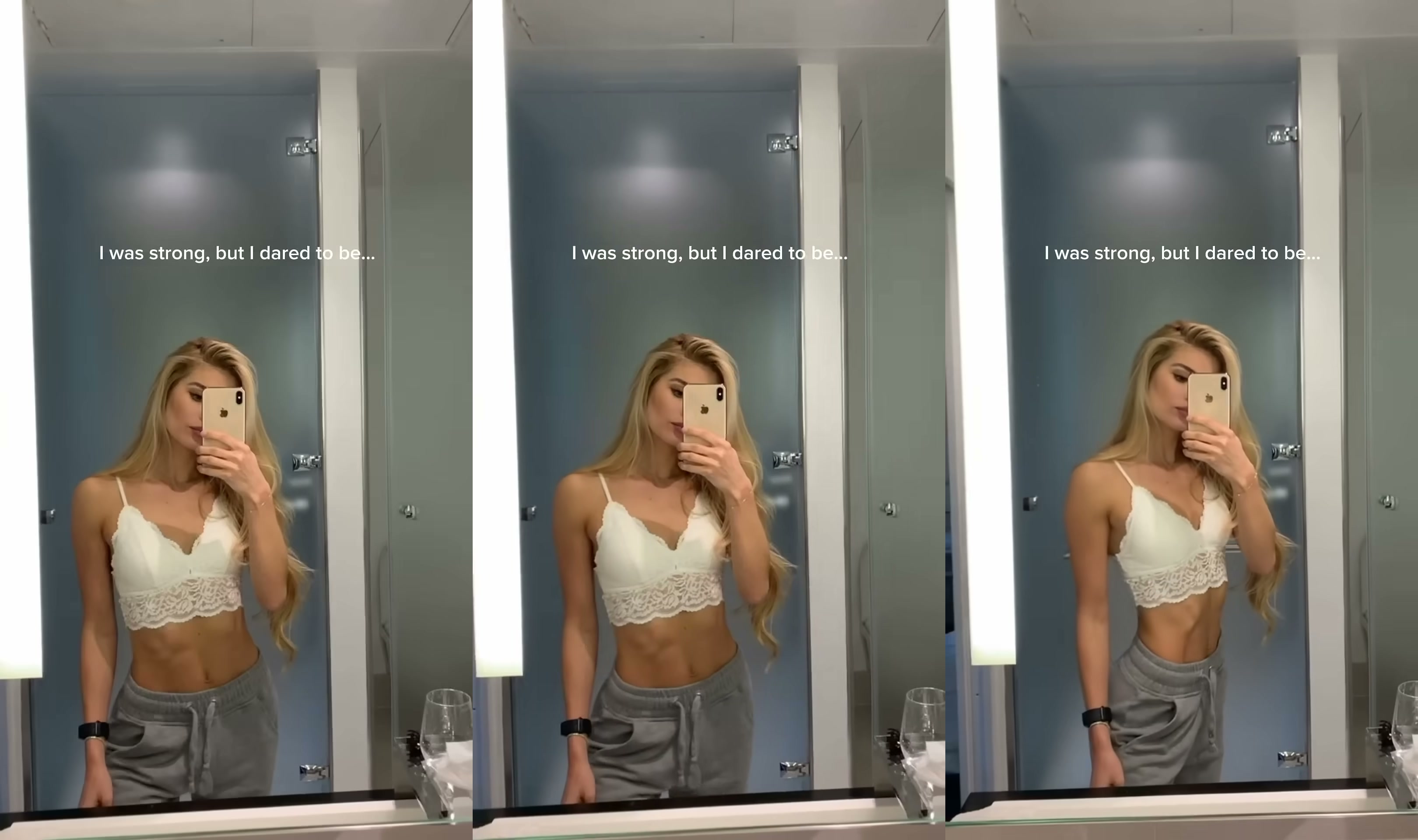
The narrative function of that baseline is precise. Because the edit opens on someone already trained, the arc it proposes is not "flawed → fixed" but "strong → stronger." That choice does two structural jobs at once. It removes the redemption frame that before/after content depends on, so no split screen is ever needed — the video never argues a correction, only an addition. And it pre-loads the +7kg number with meaning before the number appears: in a loss-tuned feed, an unframed "gain" reads as backsliding; framed from a strong baseline, the same number reads as investment. The soft, melodic intro — identified in the original June 2026 pass as a remix of an Adele track — holds this section in reflection rather than spectacle, which is what keeps the opening honest as a check-in instead of a brag.
One number, placed exactly on the turn
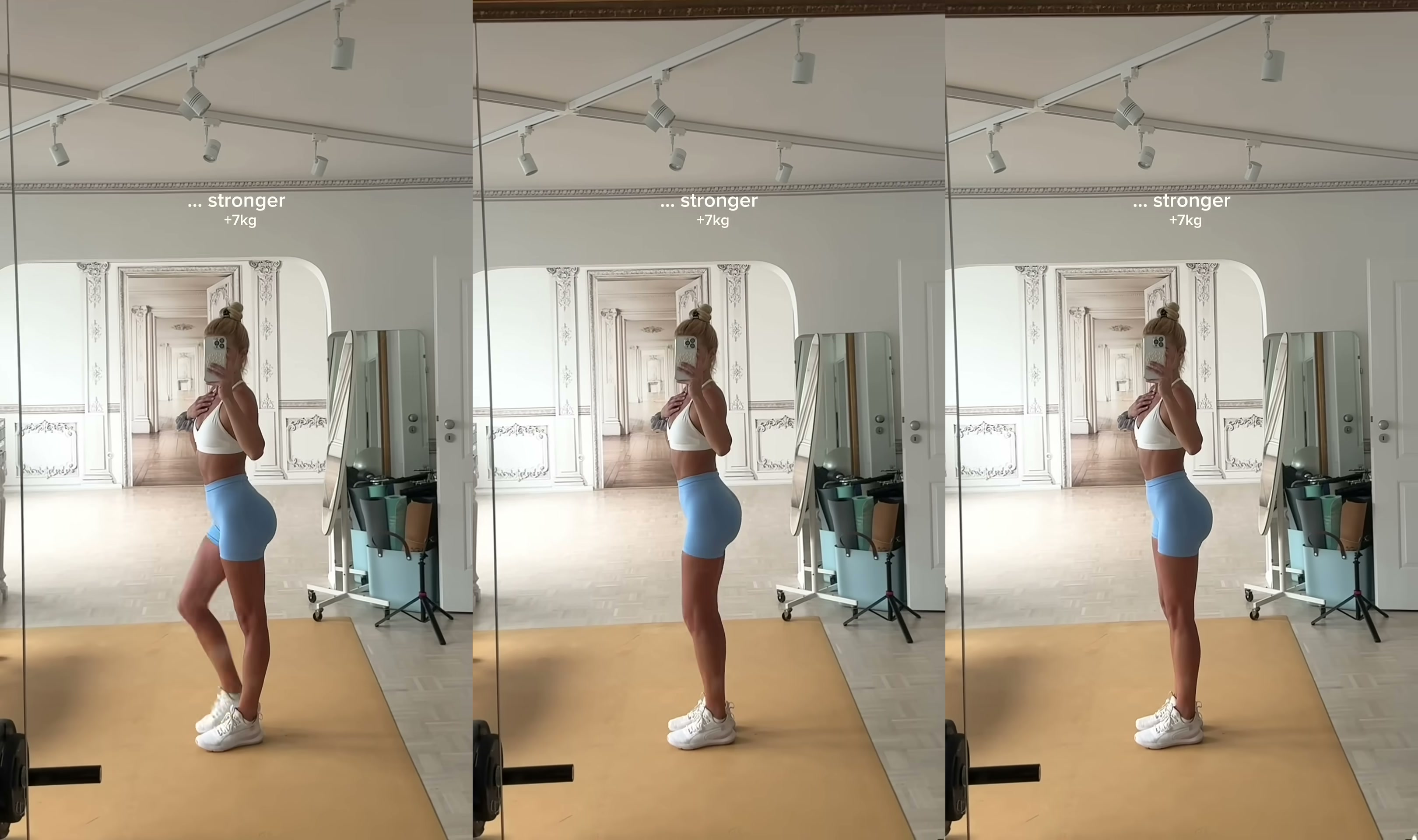
The text overlay arrives in two installments. The setup line — "I was strong, but I dared to be…" — sits over the opening. The payoff, "…stronger +7kg," lands at roughly 4.8 seconds, timed with the beat drop, and the shot immediately following it is a posed flex: the frame captured at 4.8s pairs the number with a display of capability.
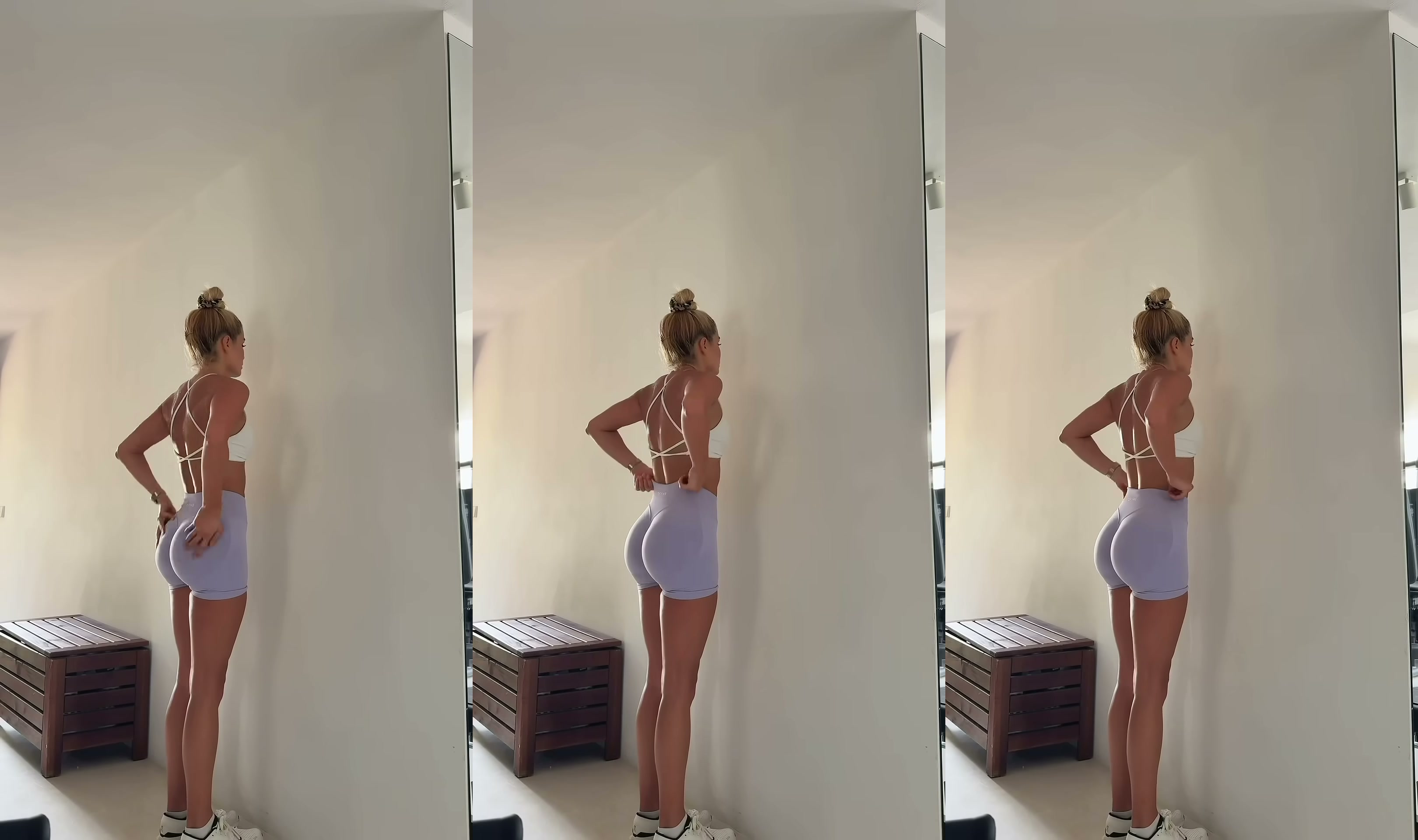
Three editing decisions are doing the work here. First, the claim is quantified — a specific number reads as something measured rather than felt, and as on-screen text it survives mute and autoplay, where a spoken claim would not. Second, it is placed at the structural turn of both the text line and the track: the sentence completes and the beat drops on the same beat, so the music's energy change endorses the number instead of competing with it. Third, the number is answered instantly by a proof shot. The sequence is claim → evidence, with no gap in which the audience's default reading of "weight gain" can take over. What the shot proves is capability as posed by the creator; the edit's job — and the lesson — is that the proof beat exists at all, immediately, on the turn.
Settings that prove instead of claim
After the turn, the locations escalate, and each setting upgrades the kind of claim the video is making. The bathroom was self-report. The frame at 8.5s moves to a Pilates reformer — equipment footage, which demonstrates function rather than asserting it.
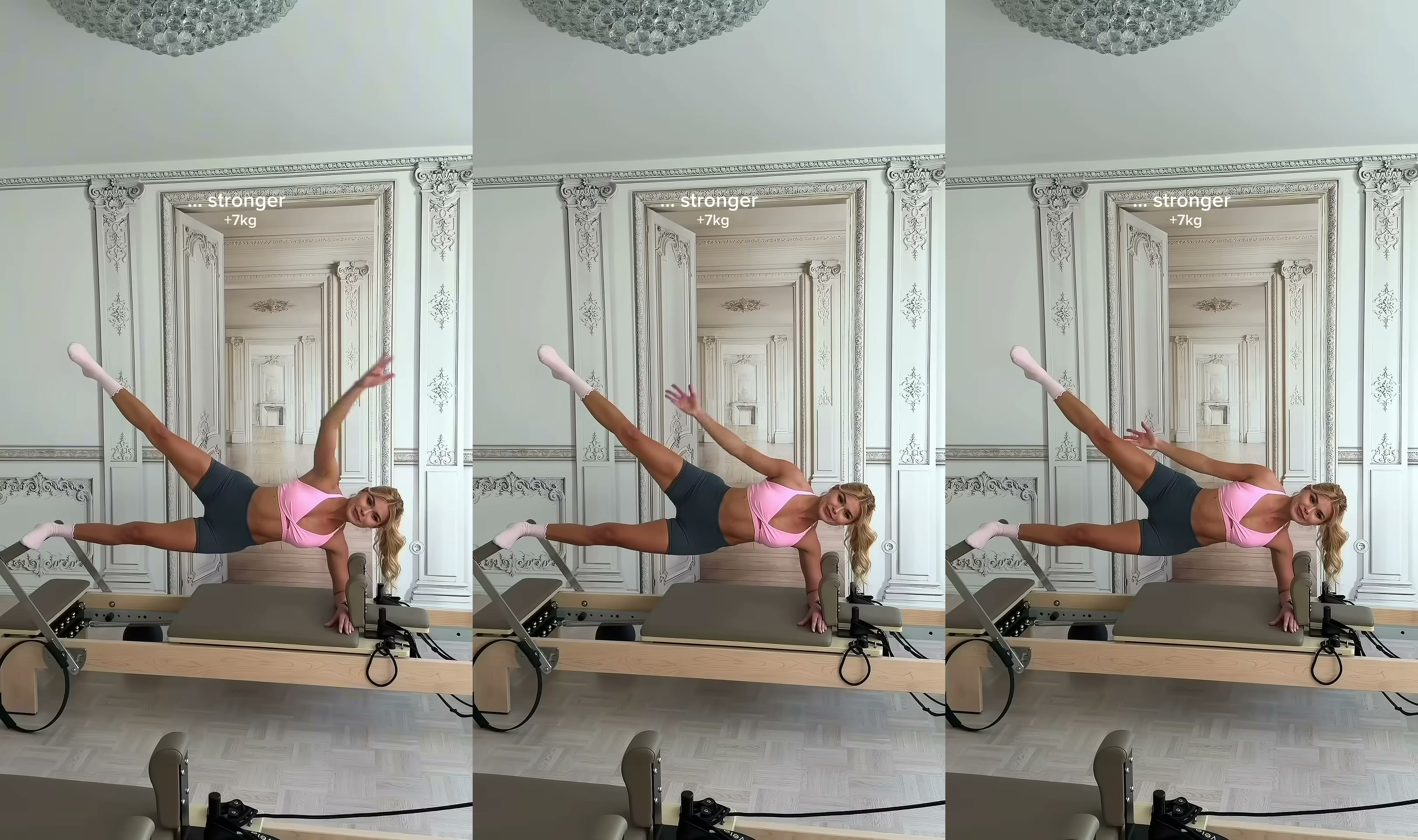
The final frame, around 10.5 seconds, lands in a high-ceilinged, finished room and holds a closing pose — an identity shot rather than an evidence shot, closing the arc at "this is who I am now" without saying it.
Read in order, the progression is private → functional → aspirational, and the outfits segment alongside it. That is the whole second half of the story told through location choice: the audience's trust in the +7kg claim is built by what the camera is pointed at, not by anything the caption has to insist on. This is also the part most creators under-build — a metric overlay over generic mirror clips asks the number to carry the whole claim, while equipment and setting footage share the load.
The music carries the persuasion
Mapped against the timeline, the track is doing as much narrative work as the shots. The soft melodic intro covers the baseline and holds the register of self-reflection. The beat drop at ~4.8 seconds is the story's turn — the same moment the number completes the sentence and the proof beat begins. The closing section runs bass-heavy and rhythmic under faster cuts, so the edit's energy curve and the track's intensity curve rise together.
The transferable rule is not "use an Adele remix." It is: pick a track whose structural break — the drop, the key change, the tempo lift — lands where your story turns, and place the claim on that break. When the music turns and the argument turns in the same instant, each makes the other feel inevitable. Beat-matched cutting of this kind is also the mechanical layer an AI video editor can draft for your review while you keep the judgment calls — where the turn lands, and what counts as a proof shot.
What transfers, and what does not
Reduced to its skeleton, the pattern is five decisions:
- Choose the starting frame deliberately: a "strong → stronger" arc needs a capable baseline, and it spares you the before/after device entirely.
- Split the text claim in two — setup early, payoff late — so the sentence itself creates the turn.
- Quantify the claim once, put it on the music's structural break, and answer it immediately with a proof shot.
- Escalate settings from self-report (private) to function (equipment) to identity (aspirational close).
- Let the track's intensity curve mirror the story's curve instead of merely accompanying it.
None of these decisions belong to Pamela Reif. They are structure, and structure is what transfers — applied to your footage, your metric, your music, and your story. What does not transfer: her name, likeness, footage, or specific numbers, and any instruction to recreate her video. If you want the general workflow for extracting a style from any reference clip and reapplying it to your own material — measuring pacing, overlay timing, and music mapping rather than eyeballing them — that process is maintained separately in how to copy a video editing style from a reference clip. Sparki's copy-style capability, for what it's worth, is built on the same boundary: it learns the editing recipe of a reference and never the reference's content, and it produces drafts you review rather than finished cuts.
The neighboring analysis is worth one click if you make fitness content: Katie Feeney's HYROX video is the event-coverage variant of the same genre — a spectator-to-participant hook feeding a competition montage — where this Short is the first-person transformation variant, told in twelve seconds through baseline, number, proof, and turn.
https://sparki.io/blog/pamela-reif-strength-narrative-shorts