
Slow Build, Fast Payoff: The Editing Logic of Kendall Jenner's Lip Combo Reel
A close read of one Kendall Jenner lip combo Instagram reel — the cross-handed open, off-beat hand sync, handheld breathing, and a slow build that spends itself in a final product flash — and how to run that rhythm on your own footage.

Short-form beauty editing usually pays out early: hook in the first second, a cut on every beat, momentum sustained by constant novelty. The Kendall Jenner lip combo reel examined here offers the opposite deal. For roughly thirty seconds it barely hurries — a face, two lip liners, unhurried hand movements, one soft track underneath. Then, in the final eight or so seconds, the cutting rate multiplies: products flash between her fingers several times a second, a flat-lay lands, and the reel closes on a kiss. The waiting is not a cost the edit pays on the way to the payoff. The waiting is what makes the payoff land.
None of that effect depends on who is on camera, which is the reason it is worth breaking down. The slowness holds attention because it is engineered: hand motions land on the weak beats of the track instead of the strong ones, match cuts trim against a still and centered face, and a fixed vanity framing carries just enough micro-movement to feel handheld rather than mounted. The burst works because it spends the attention the slow half banked. Those are editing decisions — a tempo plan, a sync grammar, a framing choice, a screenshot slot — and every one of them can be run on footage of your own products and your own hands.
This is an analysis of a cutting rhythm, not an invitation to copy a person or her content. Everything below comes from one Instagram reel, captured in April 2026 when this article was first published, and every claim is either observable in that capture or marked as interpretation. The recipe transfers to your footage. The face, the name, the L'Oréal products, and the lace loungewear are not part of the recipe.
One Reel, One Close Read
The reference is a lip combo reel posted on Instagram: liner applied first, edges blended with a fingertip, gloss layered on second, then a rapid product flash to close. At capture in April 2026 it showed roughly 553K likes and about 3,600 comments — a dated snapshot of one post, not a claim about her account and not a live number. All timestamps below refer to that capture.
One reel is one reel. Treat this as a close read of a single edit that happened to travel, not as a documented long-term Kendall Jenner style, and test the ideas against your own footage before trusting any generalization.
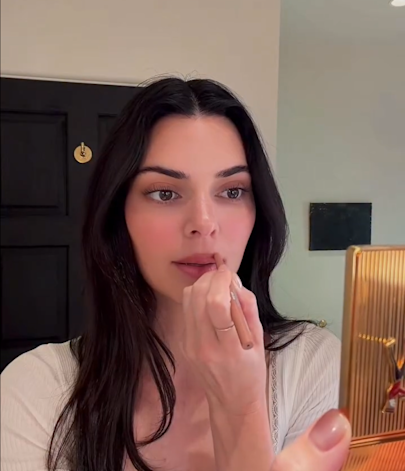
The Shape of Forty-Eight Seconds
The reel's structure is a three-movement tempo plan, and the movements are not equal in length. The hold runs from 0:00 to 0:29 and contains almost the entire application. The turn is a single moment at about 0:30. The spend, from roughly 0:39 to 0:47, is where the edit converts patience into density.
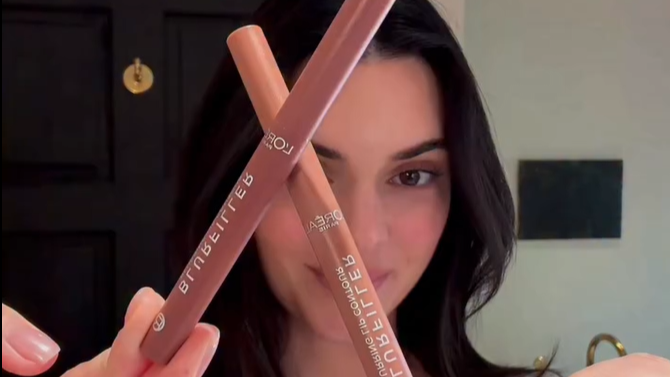
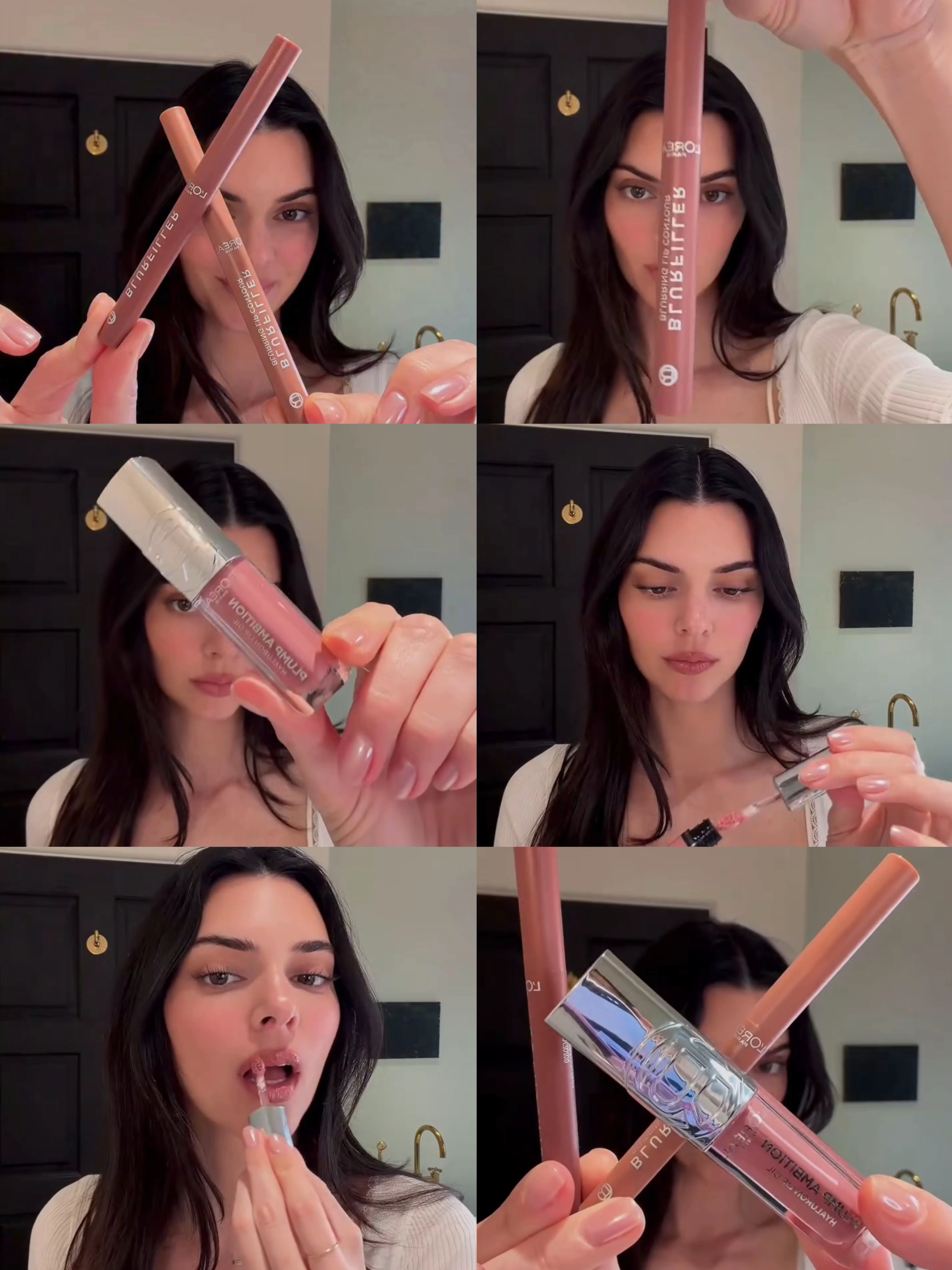
The hold opens not with a face but with a composition: Kendall holding two lip liners in a crossed-hand pose that partially veils her face. The pose does three jobs at once. It places the products at the visual center before anything else registers. It frames her eyes over the crossed pencils, so the gaze and the goods arrive in the same glance. And it plants the small question that powers the next half-minute — two similar shades, which goes where? — which the application then answers. That is the engine of a slow opening: a question plus texture, not a countdown.
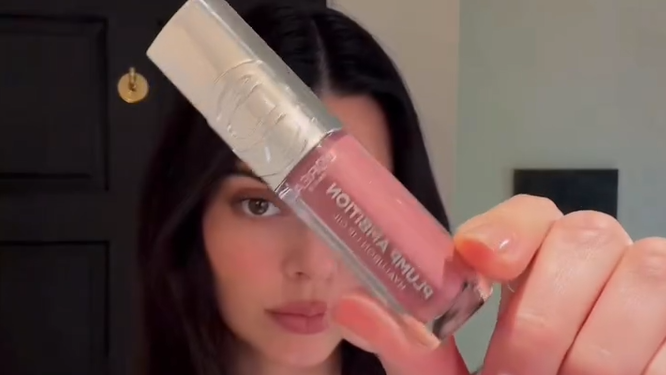
The turn is the gloss. At about 0:30 the reel leaves the base-shaping phase and enters high-shine, and the edit marks the boundary with a change in point of view and light rather than with any effect. The spend then reverses the cutting rate entirely: from one hard cut every four to six seconds to several cuts inside a single second, products flickering between her fingers, ending on a flat-lay and a blown kiss.
This is the deliberate opposite of the calm-cut GRWM tempo, where framing consistency buys cutting speed and the pace stays even from start to finish. Both edits protect a single fixed setup. But where the calm-cut spends its calm evenly, this edit banks it and spends it all in the last eight seconds — trading step compression for texture, and evenness for a finale.
How the Slow Half Earns Its Time
The application phase looks unedited in the way expensive things look effortless, and the craft is in what gets trimmed. Her face stays almost perfectly centered and still while the cuts jump between hand actions — around 0:10, from lining the upper lip to defining the lower one; around 0:18, from the pencil to a fingertip blending the edges. Everything between actions is cut away, so a twenty-nine-second tutorial reads as one continuous, lag-free session. These are match cuts doing quiet compression work: same framing, same face, new gesture.
What the hold lingers on is product evidence. The camera closes on the pencil tip as it traces the Cupid's bow and the corners of the mouth, letting the creaminess of the liner demonstrate itself rather than describing it. At 0:05 a sharp cut to the packaging lets you identify the exact product mid-tutorial — a recall beat that does the naming job a caption would otherwise do. At 0:25 a fingertip taps and blends the lip edges, a small authentic gesture that doubles as proof of blendability. In an edit with no voiceover, these close-ups are the copy.
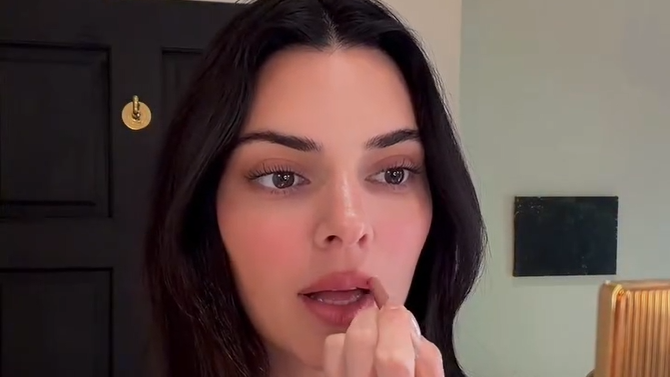
The framing never changes, and that restraint is what makes the intimacy read as lived-in rather than manufactured. The whole reel appears to come from one fixed medium shot at vanity-mirror height, mimicking the eye level of someone sitting across from her. Yet the image is not locked down: it carries a subtle micro-jitter, a handheld breathing, that keeps the footage on the warm side of an advertising frame. A tripod would have made this a commercial; the breathing keeps it a shared private moment.
Sync on the Weak Beats
The track is a dream-pop / chill R&B bed — airy, low-pass-filtered vocals over a sparse arrangement, with a clean, deep bassline — and the sync grammar is the most transferable thing in the reel. Five behaviors are observable in the capture. The products' first appearance at 0:00 lands exactly on the track's first beat, establishing the rhythmic pulse in the opening second. Through 0:05 to 0:25, the application gestures land on the off-beats — the and-counts between downbeats — which is why the routine reads as unhurried without ever reading as off-music. Each motion's start and stop, lifting the pencil and dropping the hand, falls on bar lines. At about 0:30 the track's bass emphasis coincides with the switch from side-profile application to a direct close-up. And at 0:39 to 0:41 the product flashes land on the track's fastest subdivisions, the glitch-level grid, which is why the burst feels explosive rather than chaotic.
Distilled into a working rule: syncopate the gestures, grid the starts and stops, and save strict quantization for the finale. Weak-beat placement is what separates effortless-looking beauty edits from mechanical ones; a hand motion that lands on a downbeat demands attention, while the same motion on an off-beat simply feels musical.
The Turn at 0:30
Every slow-build edit needs one moment where the ground shifts, and here it is the gloss entering at about 0:30. The divide it creates is textural: matte, shaped lips on one side, mirror finish on the other. Between 0:33 and 0:36 the light effectively goes high-key on the gloss's reflections, and the visual payoff of the entire routine — shine — is allowed to peak. Her gaze shifts at the same boundary, from a focused downward look during application to direct eye contact with the lens afterward. The edit cuts the turn on the track's strongest accent, so music, texture, and point of view all pivot in the same second. One pivot, fully committed, does more than a series of partial ones.
The Last Eight Seconds Spend Everything
The finale changes exactly one variable: cutting frequency. The framing stays the fixed medium shot it has been since 0:00, but cuts now arrive several times per second as the products flash between her fingers. The transitions between flashes are not effects — the motion blur of her own hand movements functions as the wipe, so the density reads as play rather than as editing. Around 0:39 a quick cut presents the full combo laid out together, the flat-lay that serves as the reel's screenshot slot: the one frame a viewer can capture to replicate the look or shop the products. The close stacks the payoff gestures — face resting on hands, a smile, a playful look, a kiss blown while holding the hero product — and ends on an image light enough that a loop restarts without friction.
The Look That Licenses the Slowness
Slowness only survives when every held frame rewards looking, and the grade carries that load here. A subtle soft-focus treatment smooths the skin while keeping the lashes and lip contours sharp, which reads as premium rather than blurry. Warm indoor light produces gentle halation around the frame edges, giving the footage a cinematic bloom instead of a flat recording. The palette is disciplined to the point of choreography — off-white loungewear, deep brown hair, beige and tan room tones — so the nude-pink lips and products carry nearly all of the color emphasis in every frame. Shadows are lifted, the overall key is bright, and within a single face the grade plays matte liner against mirror gloss; that texture contrast is the visual plot of the whole video, compressed into one frame. None of this is exotic equipment. It is restraint applied consistently for forty-eight seconds.
No Words, One Moving Label
There is no dialogue, no voiceover, no captions, and no overlays anywhere in the reel. The only text in it is printed on the packaging, and the L'Oréal Paris logo crosses the lens whenever her gestures carry it there — native branding instead of a lower third. The logic is worth stating plainly: when the visual field is this clean, the product is its own label, and an overlay would spend the composition's calm to say something the packaging already says. The silence also changes the viewer's job. With nothing to listen to, you watch every detail of the application instead of waiting for the narration to reach the point. Selena Gomez's no-dialogue red eyeliner routine proves the same point at the opposite tempo — the same silence wrapped around jump-cut transformation instead of a slow texture study.
Running the Slow Build on Your Own Footage
The tempo plan compresses into three cutting rules, one per movement:
| Movement | What the reference does | Cutting rule for your edit |
|---|---|---|
| Hold (first two-thirds) | One clear action per cut, hard cuts every 4–6 s, gestures on the off-beats | Let each gesture finish; cut on the action, syncopate the hands, keep starts and stops on bar lines |
| Turn (one moment, about four-fifths in) | Gloss entry cut on the bass emphasis; texture and point of view swap together | Choose one pivot — texture, angle, or gaze — and cut it on the track's strongest accent |
| Spend (final ~8 s) | Several cuts per second, product flashes on subdivisions, one flat-lay slot | Reveal every product rapid-fire, include one static flat frame for screenshots, end on a light gesture |
The production side has three constraints worth honoring before you open an editor. Shoot one setup, handheld at vanity height in warm light, and let the breathing stay in the footage. Choose your two textures in advance — your version of matte-then-mirror, whether that is cream then gloss, bare then swatched, or satin then foil — because the turn needs a visible before and after. And perform every gesture to completion on camera, since match cuts need whole actions to trim between. Shoot the spend's materials separately: a flat-lay of the full lineup, plus quick handheld lifts of each individual product.
In the edit, lay the music down first, because everything rhythmic is decided against it. Build the hold by anchoring each motion's start and stop to bar lines while letting the gestures themselves sit on the off-beats. Place the turn on the strongest accent you can find rather than on a convenient cut. Quantize the finale's flash cuts to the track's fastest subdivisions, drop in the flat-lay as the screenshot slot, and close on a gesture that would survive being the thumbnail. If you brief an editor instead of working a timeline, the whole plan compresses to a sentence: keep the first two-thirds unhurried with gestures on the off-beats, put the texture swap on the biggest accent in the track, then flash every product on the fast subdivisions and end on a flat-lay.
Sparki — the product we build, so weigh this as a disclosed bias rather than a neutral review — handles this pattern through copy-style: it analyzes a reference edit, extracts the cutting recipe, and applies that recipe to footage you already shot. The boundary is the same one this article keeps drawing: it learns the rhythm, not the content, and it works on your products and your hands rather than generating new video. For the full method of decomposing any reference into measurable signals — pacing, BGM relationship, transition logic, energy curve — see how to copy an editing style from a reference clip.
What Transfers, and What Doesn't
The asset in this reel is not access to a supermodel or a prestige brand deal. It is a tempo contract with the viewer: patience, offered beautifully, will be repaid with density. You can honor that contract with a phone, a window, two textures, and a track with a clear accent — and the result will read as expensive precisely because you resisted spending early. What does not transfer is everything else: the face, the name, the products, the lace. Keep the analysis honest in both directions, and remember that it rests on one reel watched closely, not on a career's worth of footage. The rhythm is the part you can own.
https://sparki.io/blog/how-to-edit-a-high-end-lip-combo-video-like-kendall-jenner