
How Bayashi TV Edits Food Shorts: Sound-First Cuts, Nested Suspense, No Music
A close read of one Bayashi TV food Short from June 2026: audio-first cuts, a nested-ingredient suspense loop, dual-fry process grammar, and a payoff the edit spends 32 seconds earning.

A few seconds into one 39-second YouTube Short, a frying sound starts while the picture has not changed yet. The creator is still slumped in pajamas, scrolling his phone to a calm rain video. Only after the sizzle registers does the cut arrive, dropping the viewer into a bright kitchen where a potato is already being hollowed out. Sound before picture: that is the first rule of how Bayashi TV edits food videos, and the rest of the clip builds on it so consistently that one Short is enough to reverse-engineer the whole format.
This page is that read. It walks through what the cuts, the audio, and the staging of one captured clip are actually doing, separates what is transferable editing technique from what is one creator's signature, and points to the pages that own the adjacent questions. The format-generic craft — shot order, the four sensory food formats, tool selection — lives in our food video editing guide, and the sound-first workflow in detail lives in the food ASMR editing guide. What only this page covers is the specific grammar of this channel's cook-along format.
The Sample: One Short, Captured June 2026
Video: Chicken inside a potato (YouTube Short)
Creator: Bayashi TV (@BayashiTV_) — 36.4 million subscribers at the June 2026 channel snapshot
Published: 2026-06-13, 39 seconds
Stats at capture (late June 2026): 6,506,216 views, 225,269 likes, about 1,000 comments
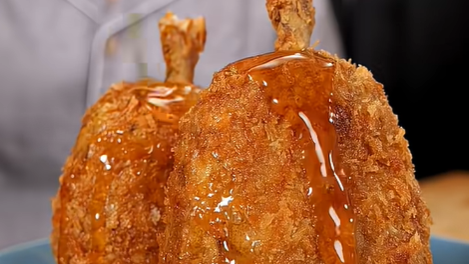
Every observation below comes from this one clip, with channel-level figures dated to their snapshot. View counts move; nothing in the analysis depends on the numbers staying put. The point of fixing the sample is the opposite — the editing grammar does not move, and that is what is worth studying.
Sound Arrives Before the Picture
The clip opens on a universal scene: late-night scrolling in pajamas. The rain video on the phone is quiet, almost sleepy. Then the sizzle enters the audio track a beat before the image cuts to the kitchen. The ear accepts a new scene faster than the eye does, so the transition feels inevitable rather than edited — the viewer is already in the kitchen by the time the cut confirms it.
That audio-first logic runs the whole edit. There is no music anywhere in the 39 seconds; the only track is the kitchen itself — the thud of a potato hitting a board, the crinkle of foil, the hiss of oil, the snap of a crust. Cut points land on those transients rather than on visual beats, which is why the rhythm of the piece survives with your eyes closed. The mix reads close and dry, consistent with a microphone placed near the action; the capture setup is not confirmed, so treat that as an inference — the observable fact is that transients are clean and forward, nothing fights them for attention.
This is the same sound-first discipline that food ASMR editing formalizes — protect the original audio, cut on the waveform peaks, keep music out or ducked far under. The full workflow, including what to clean and what never to flatten, is in our food ASMR editing guide; the part specific to this channel is that it applies the discipline inside an aggressive 0.5-second cut grid, where ASMR editing usually slows down.
The Nested-Ingredient Loop: Suspense Instead of a Front-Loaded Reveal
The dish is a Russian doll: a potato hollowed out, a deboned chicken breast tucked inside it, sealed, cooked. The construction is the story engine. From roughly second 7 to second 32, the edit cuts every 0.5 to 1 second and only ever shows the next step — never the result. What goes in is visible; what comes out is not. The question "what does that potato look like opened?" stays open for about 25 seconds, and every cut renews it instead of answering it.
This is the most instructive place where this format diverges from generic food-short structure. The standard advice — argued in our food video editing guide — is reveal-first: put the money shot in the first two seconds, because a chronological open spends your three riskiest seconds on a chopping board. This clip is the counterexample that proves the rule's boundary: when the process itself hides a secret, a front-loaded reveal would destroy the only asset the video has. A nested construction buys roughly 25 seconds of guaranteed attention and lets the payoff live at the end. Reveal-first is the default when there is no loop; a hidden filling replaces it with something stronger.
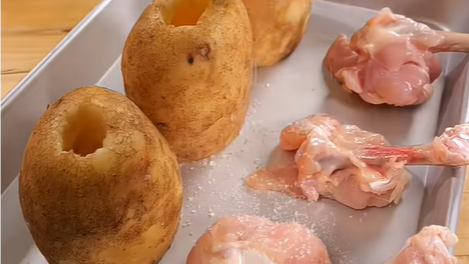
The loop, not the dish, is the transferable device. Any concealed element works toward the same mechanics — a stuffed protein, a filled pastry, a sauce hidden under a lid. The specific chicken-in-potato build belongs to its creator; the structure (hide the answer early, spend the middle earning the question, resolve in the final seconds) is a recipe anyone's own footage can follow.
Process as Proof: The Dual-Fry Grammar
Seconds 16 to 24 compress the cook into a montage with a technical signature: the packet goes into an air fryer for internal doneness, then into a deep fryer for the crust. No dialogue explains why; the two appliances simply appear in sequence. The detail reads as expertise — this is presented as a professional's method, not a home cook's shortcut — and it upgrades the middle section from filler to proof of craft. Process density works the same way in other fast-cut food content: cuts landing on completed actions (the spoon touching the plate, the knife finishing a stroke) make a montage feel informative rather than merely fast.
The second observable discipline here is the locked camera. Through the fastest cutting, the frame stays static — locked-off angles, no pans, no handheld drift. That is not laziness; it is what licenses the aggression. With a stable reference frame, a 0.5-second cut reads as information; add camera movement to the same cut rate and it reads as disorientation. Static camera plus fast cuts is a trade: the edit sacrifices camera expressiveness and buys cutting speed with it.
No Face, No Music, Black Gloves: The Signature Layer
Three absences define the presentation: the creator's face never appears, no voice or dialogue is heard, and no music plays. What replaces them is a set of small, consistent signatures. The opening pajama scene supplies the person — someone with a late-night craving, not a performing host — and hands the personality over to the food for the remaining 35 seconds. The black gloves do quiet visual work in the macro shots: dark neutral hands keep the frame about the ingredients, and skin tones never compete with the ambers of fried food. This is how faceless formats stay personal and recognizable — identity carried by props, hands, and habits rather than a face.
A boundary is worth drawing here, because it is easy to miss. The gloves, the facelessness, the pajama hook — this layer is identity, not technique. Macro shots over neutral dark gloves is a craft choice any cook can make for the visual reason above. Adopting the entire stack because one channel is big with it builds that channel's brand, not yours. The sections of this clip worth borrowing are the ones analyzed above — the cut logic, the loop, the speed structure — not the costume.
The Payoff: Where the Edit Slows Down
From second 25, the video assembles its climax: the packet is opened, the chicken goes into a waffle, syrup pours over the crust. At roughly second 32, the pace drops for the first time — a slow pull-apart, steam rising off the interior, the reveal of the chicken inside the potato. After 25 seconds of half-second cuts, the sudden linger reads as physical relief, and the reveal is held as the longest single shot in the clip. It ends the video there.
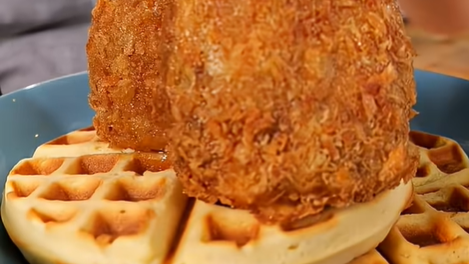
The lighting and grade serve that final shot: high-key exposure lifts shadows off the food, and the warm, saturated ambers of syrup and crust are pushed in post. The observable principle is not any color theory — it is that the entire visual pipeline is aimed at texture (crust, pour, steam) at the exact moment the story resolves. The two-speed contrast does the rest. Fast without the slow feels chaotic; the slow only lands because the first 30 seconds earned it.
Reading It as a Recipe, Not a Template
Collected, the transferable recipe in this clip is short: let sound trigger the cut; build an open loop in the first ten seconds and resolve it in the last five; compress process into fast cuts on action beats under a static camera; slow down exactly once, at the payoff, and end there. That is an editing recipe — a set of decisions about rhythm, sound, and structure — and it can be applied to anyone's raw cooking footage.
What does not transfer: the creator's identity stack, his recipes, and his footage. A reference clip is a recipe source, never a material source — cutting his frames into your own video is both a rights problem and a brand problem. Done properly, style transfer reads the reference's editing decisions and re-applies them to your own clips, which is the method we describe in how to copy an editing style from a reference. Sparki, the product we build, implements exactly that boundary: its copy-style feature reads a reference for its cut grid, speed structure, and sound logic, then assembles your uploaded footage to that recipe — none of the reference's frames appear in the output. For the broader question of which editing approach fits food footage you already have, the four-family comparison lives in the AI food video editor guide.
Food shorts have an opposite pole, and it is worth knowing which one your material belongs to. Where this format is faceless, silent, and built around cooking, Brooke Monk's Disney park food review is on-camera, music-backed, and built around rating — the same audience category with an inverted grammar, analyzed in our Brooke Monk food review breakdown.
The takeaway from this clip is not "cook a chicken inside a potato." It is that 39 seconds can spend 32 of them making one question unavoidable and pay it off in seven — with no music, no face, and no camera movement to help. That structure is borrowable. The dish belongs to him.
https://sparki.io/blog/how-to-master-viral-food-content-creation-like-bayashitv