
The Ghost of "Editing Past": Why You Never Edit Your Raw Footage (And How AI Fixes It)
Drowning in terabytes of files? Sparki's AI agent automates the 1:6 editing tax. Instantly sift selects, identify usable B-roll, and sync beats without the manual grind.

It's mid-December. The year is winding down, but your hard drive is spinning up.
If you're like most creators—or the designated 'tech person' in your family—your phone and camera are probably filled with gigabytes of untapped potential. You've got hours of footage from that chaotic summer road trip you swore you'd edit 'next weekend,' and now, as everyone gathers for Christmas dinners and holiday gaming parties, you're stuck in front of your screen, painstakingly sifting through footage, while the laughter and cheers echo in the background.
You have a vision. You want to make a montage. You want to capture that specific feeling, set it to the perfect track, and share it while the memory is still fresh. You want to be the person who actually sends the video, not the one who promises to "get to it soon" until it becomes awkward to bring up.
But you haven't started. Why? Deep down, you know the truth: If you don't edit it now, it will likely never happen.
We all have that 'Digital Graveyard'—external hard drives collecting dust, packed with terabytes of memories from 2025, 2024, and beyond, waiting for edits that never came.
We tell ourselves we are just "waiting for the right time" or "need to find the right music."
As the founder of Sparki and someone who's been through the grind as a creator, I know that feeling in the pit of your stomach isn't about your schedule. It's not a lack of creativity.
It's the dread of the "Montage Tax."
It's the subconscious knowledge that for every minute of joy you want to share, you have to pay an excruciating toll in mechanical, soul-crushing labor.
The 1:6 Time Trap (The Reality Check)
We didn't just guess that editing was hard. We wanted to quantify exactly why it feels so heavy. We analyzed thousands of discussions from professional editors, streamers, and hobbyists in Reddit communities.
We wanted to find the friction points. What we found was a math problem.In one memorable post, a creator shared a statistic that defines our collective nightmare: '2 hours of footage somehow turned into nearly 12 hours of editing work.'
That's a 1:6 Time Tax.
For every minute of content you want to produce, you are paying six minutes of your life in pure labor. And that's a conservative estimate. For high-end gaming montages or intricate travel vlogs, that ratio can balloon even higher.
Think about that in the context of your Christmas holiday. If you filmed just 3 hours of Christmas morning—the gifts, the breakfast, the laughter—are you really prepared to spend 18 hours staring at a screen just to sift through it?
This is what we call "Sifting Fatigue."
Most people think editing is about "cutting." But the real pain happens before you make a single cut. It happens in the culling. It is the mechanical labor of scrubbing through timelines, looking for that one laugh or that one clutch play, while deleting "pointless silence" frame by frame.
| Pain Point Category | Specific User Feedback (Direct User Quotes) | Pain Level | | Time Strain | "2 hours of footage somehow turned into nearly 12 hours of editing work." | Extremely High | | Mental Fatigue | "Sifting through all the footage to find content." | High | | Self-Loathing | "Making me upset at myself... editing past the UMs and UHs." | Medium/High | | Primitive Tools | "Jotting down timecodes in Notepad... viewers could hear." | High | | Workflow Strain | "Manually go through... singling out... huge pain." | Extremely High |
One user put it perfectly: "I actually kinda enjoy editing, but my problem is sifting through all the footage to find content worth working on."You aren't editing; you are acting as a majestic garbage collector for your own digital life.
The Psychological Toll (It's Not Just Boring, It Hurts)
There's a darker side to this 1:6 ratio that tools rarely address: Self-Loathing. When you're the editor of your own life, you are forced to confront your imperfections on a loop. You don't just see the happy moments; you see the setup, the failed takes, and the awkward pauses.
-
You hear every "um" and "uh" you say.
-
You see every time you adjusted the camera and looked unflattering.
-
You watch your failed jokes land in silence.
One user shared how editing their streams made them feel 'upset at myself.' It's a relatable sentiment for many creators who are often forced to relive their awkward moments while editing.
They described how cutting out their own stutters and silences made the video feel 'choppy' and 'low quality,' which led to feelings of frustration, thinking their content was beyond saving.
This is the hidden cost of the manual workflow. You aren't just losing time; you're losing confidence. By the time you finish the edit (if you ever do), you're often too sick of the footage to even enjoy the memory.
So, the real question isn't "How do I become a faster editor?" It's: How do I stop paying this tax before I even start telling the story?
The "Caveperson" Workflow
If the problem is the 1:6 tax, how are we currently trying to solve it? The answer, sadly, is: "Primitives."
Despite all the AI hype, most of us are still editing like we're in the 1990s. We rely on manual, brute-force methods that Reddit users describe with words like "primitive" and "huge pain."
1. The Notepad Nightmare
Imagine you're streaming or recording a vlog. Something amazing happens—Grandma drops the turkey, or you hit a no-scope headshot. You know you want to keep that moment. So what do you do?
You panic. You stop what you're doing, grab a piece of paper or open a text file, and scribble down a timestamp. One creator shared how absurd it felt: "I was jotting down timecodes in Notepad... It hit me, I was working like a caveperson." It's a perfect example of how primitive many video editing workflows are.
They described the absurdity of the situation: their audience could hear the keyboard clacking as they typed 02:15:00 ???.
And the worst part? Post-stream, they would stare at that timestamp and have no idea what ??? meant.This is friction in its purest form. You're trying to live a moment, but you're forced to be a data entry clerk.
2. The "Asset Scavenger Hunt" (Asset Fragmentation)
Let's say you've survived the sifting phase. Now, you're ready to add some flair to your video. Maybe you want to throw in a meme for a punchline, or add some cinematic B-roll to smooth out transitions between scenes. Welcome to "Asset Fragmentation."
You've got the footage, but now you're missing the right assets. Suddenly, you're opening 50 tabs, searching YouTube for "Spongebob 5 minutes later," scrolling through royalty-free sites for a "cinematic drone shot," and hunting for a sound effect that perfectly captures the emotion you want.
One creator put it perfectly: "Finding a niche meme, or a meme that fits that exact emotion, is way harder than it should be."
You know what you're looking for—you can almost feel it—but it's nowhere to be found. Creators end up spending more time managing files and folders than actually creating. Your flow is gone; you're now just a file manager.
3. The "Gun Sync" Hell
Then comes the music. You want the cuts to land on the beat. You want that satisfying "pop" where the visual action aligns perfectly with the audio track.
In the gaming world, this is called "Gun Sync." It's an art form. It requires analyzing the audio waveform for bass peaks and cutting the footage exactly at the shot.
One editor mentioned how tedious the process was, but also said it was 'doable. They described the workflow: "Let the music play... tap a key every time you hear a beat to drop markers... then move the visuals."
"Doable." Is that really the standard we accept for our holidays?
Spending hours tapping the M key on a keyboard just so our family dinner video isn't off-beat?
The Solution: The Smart Cut (How Sparki Works)
I built Sparki because I refused to accept that "12 hours of work for 2 hours of footage" was the only way to create.
Sparki is not just another video editor with a "Magic Wand" button. It is a ConversationalAI Video Editing Agent. The difference is crucial. A tool waits for you to click.
An agent acts on your behalf.I designed Sparki to handle the "non-creative labor"—the sifting, the syncing, the scavenging—so I (and you) can spend time directing the story, not fighting the software.Here's how we redesigned the Christmas Montage workflow to be painless:
Step 1: The "Dump" (Kill the File Management)
First, navigate to Sparki.io and click the "Upload" button.Don't waste time renaming files. Simply drag and drop your raw Christmas footage—the dinner, the unwrapping, the chaos—into Sparki. We want to remove the friction of "organization" so you can just start.
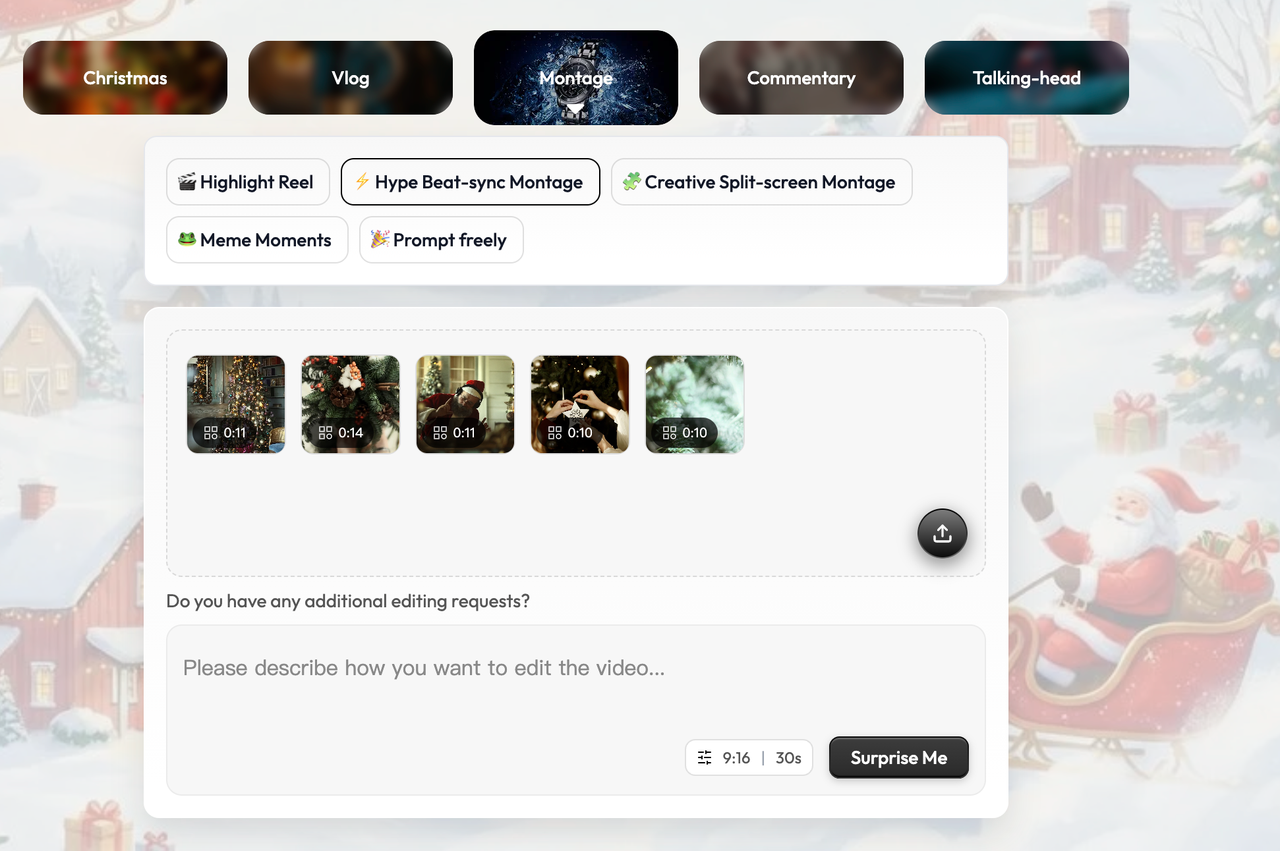
This is the asset upload page on Sparki.io, an AI-powered video editing platform. It allows users to upload video clips for personalized editing. The interface offers various options for montages, including Highlight Reels, Hype Beat-sync Montages, and Creative Split-screen Montages, ideal for holiday videos. Users can preview their clips and input editing requests to customize the final product. The page also features intuitive controls for selecting clip durations and submitting requests for automatic or creative video transformations.
Step 2: The Director's Prompt
Instead of fighting with a complex timeline and 50 buttons, just tell Sparki what you want in plain English.In the description box, you might write:
-
"Make this video upbeat, highlight the Christmas morning gift openings, and sync it to a jolly Christmas track."
-
"Create a high-energy highlight reel of my best Valorant snipes from these 3 hours of gameplay."
This is the core shift: You define the intent; AI handles the execution.
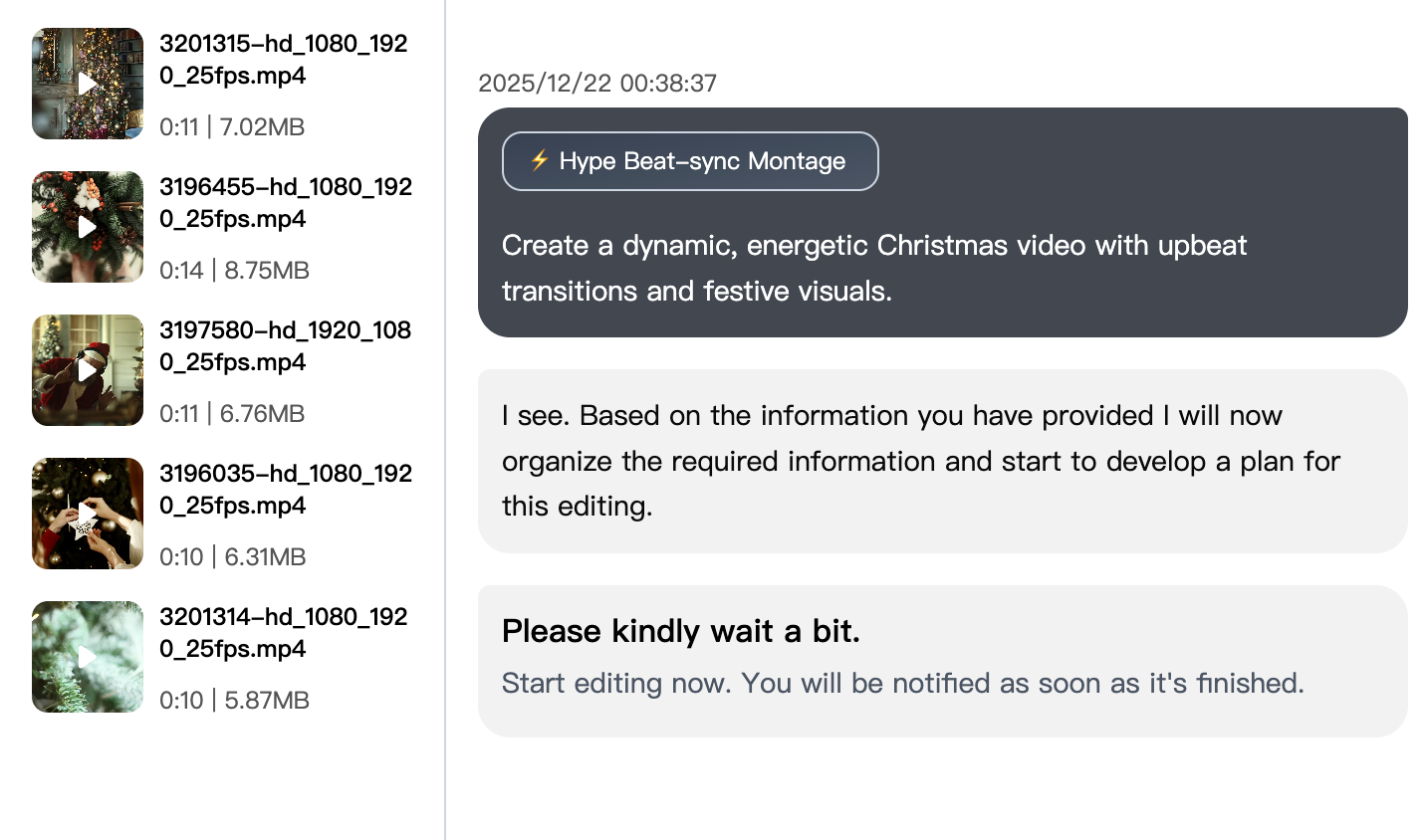
An AI-powered editing interface organizing uploaded clips and preparing a beat-synced Christmas montage in real time.
Step 3: The AI Sift (Stop Watching Paint Dry)
This is where the magic happens, and where we break the 1:6 Time Tax. Sparki watches the footage for you. It uses computer vision and audio analysis to identify High-Energy Moments.
-
It hears the laughter at the dinner table.
-
It sees the high-motion action in your gaming clip.
-
It detects the cheers when the gift is unwrapped.
Crucially, it also identifies the "Garbage Time." It automatically cuts the dead air, the silence, and the floor shots. This skips the 12-hour sifting phase entirely. You don't have to watch the boring parts; you just approve the best parts.
Step 4: Intelligent Rhythm (No More Tapping Keys)
Remember the "Gun Sync" hell? Sparki solves it with math.
Instead of you manually tapping markers, use our "Hype Beat-sync" feature. Sparki analyzes the music track you choose, mapping the beats, the drops, and the tempo changes.
It then aligns your best clips to that backbone automatically. Whether it's a "Gun Sync" for your Valorant clips (aligning the shot to the beat) or a gentle cut for a travel vlog (aligning the scene change to a musical swell), the AI handles the micro-timing. You get the professional "flow" without the frame-by-frame surgery.
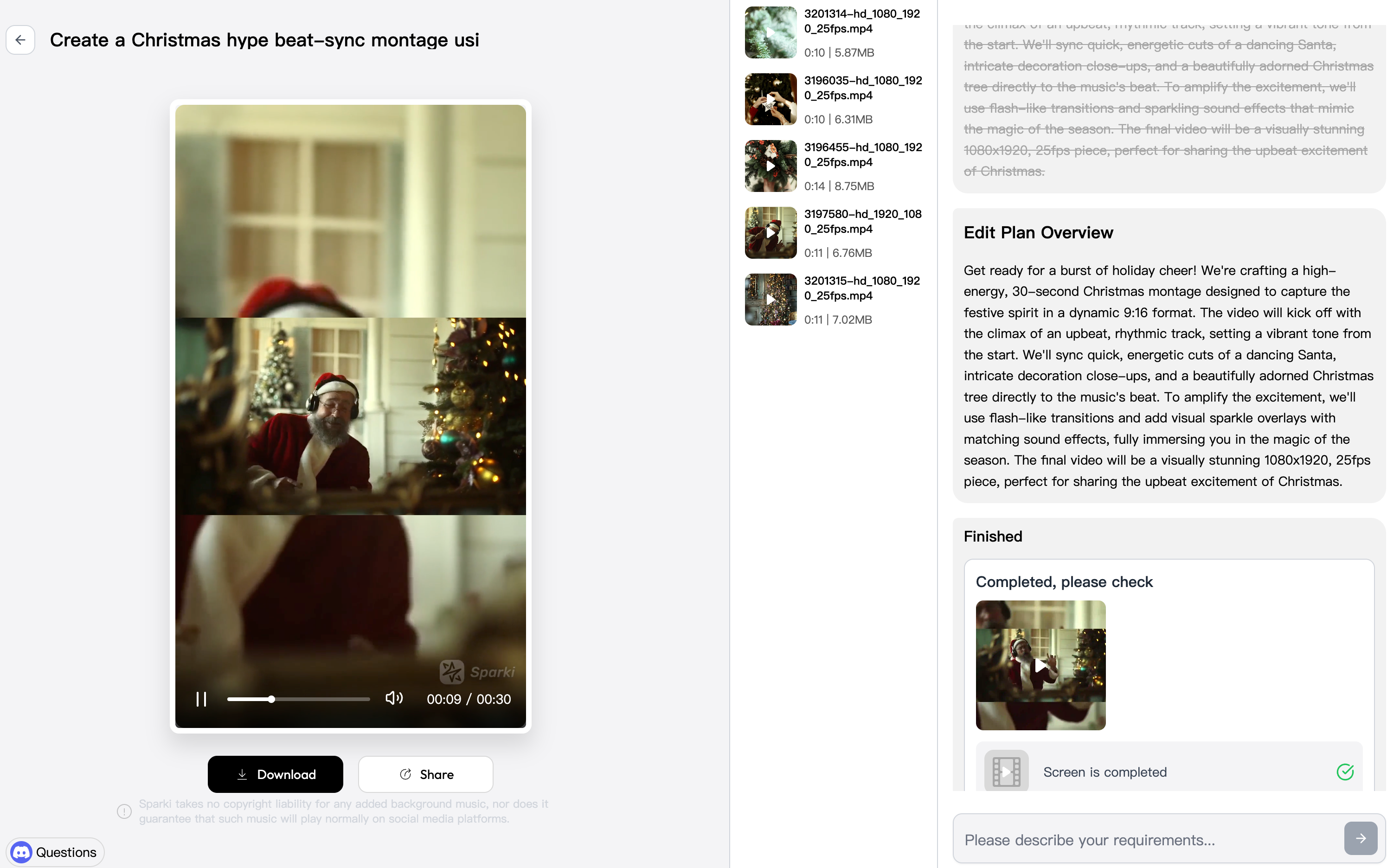
A high-energy Christmas beat-sync montage with fast cuts, festive visuals, and music-driven rhythm.
Step 5: The "Nausea Test" (Clarity Over Chaos)
This is a feature I am personally most proud of. In our Reddit research, we found a common complaint about "AI" or "Automated" edits: they are too fast. They are chaotic.
Viewers described over-edited montages as making them feel "nauseous," "dizzy," and giving them "motion sickness."
One viewer shared how speeding up the action made it hard for them to really appreciate the moment.We specifically trained Sparki to pass the "Nausea Test."
Sparki prioritizes Clarity. It understands that a shot needs to breathe to be understood. It avoids the "Over-Editing Trap" of flashing images every 0.2 seconds. It builds a narrative arc, not a strobe light effect.
The Best Gift is Your Time
We often say that "time is money," but during the holidays, time is memory.
Every hour you spend hunched over a timeline, battling software crashes, or feeling frustrated with incomplete edits, is an hour you aren't spending with the people you filmed.The tragedy of the "Montage Tax" is that it punishes you for capturing memories. It makes you dread the camera.
This year, break the cycle. Don't let your Christmas footage rot in the Digital Graveyard. Don't let the 1:6 ratio scare you away from creating.
Let the AI handle the sifting. Let the AI handle the syncing. Let the AI handle the "ums" and the dead air.You handle the story. You handle the memories.
Create your Holiday Montage with Sparki today– and finish it before dinner.
https://sparki.io/blog/raw-footage-to-montage-ai