
Kara and Nate's Viral Travel Adventure, Read Through Its Editing Evidence
A frame-level read of Kara and Nate's 88-second cliff-pod short: superlative hook, map graphic over logistics, a climb-down gate, wine-glass wind proof, and an unanswered ending.

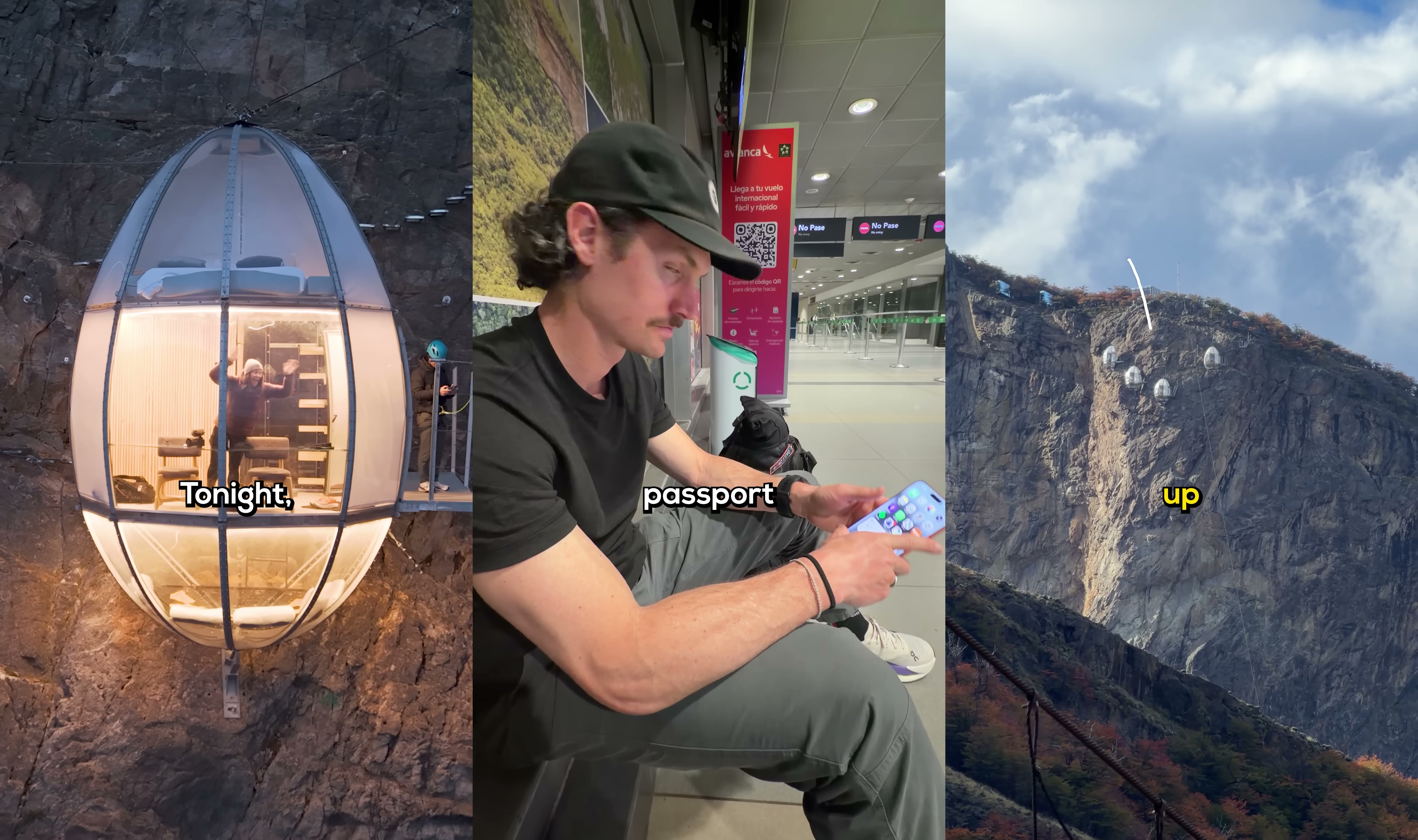
The first thing this short shows is an egg of glass glowing against a near-black cliff, a figure inside with both arms raised, and the first word of a caption: "Tonight,". Over the next 88 seconds the video makes five claims a viewer never registers as claims — that this may be the most unique hotel in the world, that the trip nearly died in an airport, that the room has to be climbed down into, that the weather turned violent overnight, and that the whole thing might not have been worth it. Every one of them goes down smoothly because the edit attaches proof to it. What follows is an inventory of that proof: five moments where the cut, the caption fragment, or a prop on the table does the arguing.
Two scope notes before the frames. This is an observation of one video — the Patagonia cliff-pod short Kara and Nate published on May 9, 2026 — checked against paused frames, with its engagement numbers recorded as dated snapshots rather than live facts. And a single short cannot testify to how a channel edits in general, so nothing here is offered as "their formula"; the three-act hook-conflict-payoff reading of this same video, and the introduction to who Kara and Nate are, live in our adventure-content breakdown of the duo. This page owns the narrower question: what is actually on the timeline.
The Sample
Video: Kara and Nate — the cliffside pod short (YouTube Short, 88 seconds, published May 9, 2026)
Observed engagement: roughly 1.38 million views and 24,000 likes as of late June 2026 — an observation snapshot taken for this analysis, not a live figure. Counts will have moved by the time you read this.
The Superlative Arrives With Its Proof Attached
The opening line — "we are staying in what might be the most unique hotel in the world" — is the kind of sentence that dies in most edits, because most edits say it over ordinary footage. Here the claim lands while the frame is already showing the thing: a low-angle night exterior of a translucent pod fixed to a sheer rock face, lit from inside, visibly occupied. The picture argues first; the words just label what the eyes have conceded. Order is the whole trick — visual before claim reads as understatement, claim before visual reads as an ad.
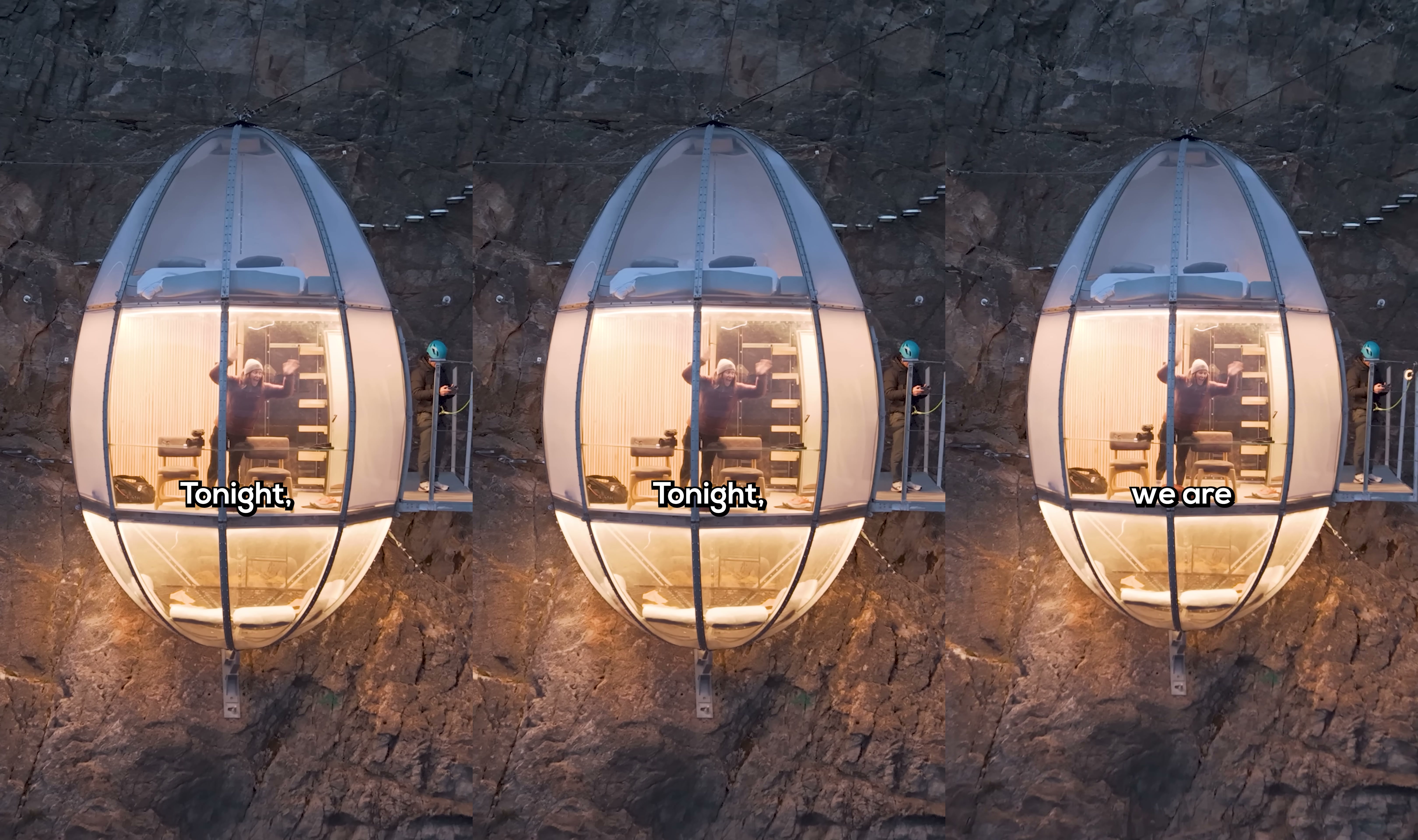
Notice what the evidence does and does not cover. The edit proves commitment — the pod exists, hangs off a cliff, and gets slept in. It cannot prove "most unique in the world," which is unfalsifiable and does not need to be; the hedge "might be" buys the superlative its cover while the impossible frame buys the hook its credibility. The first seconds also alternate exterior scale with interior warmth, so both registers — impossible and cozy — are established before any story starts.
A Map Graphic Where the Logistics Would Be
Around the 13-second mark the fantasy gets interrupted by the trip's near-death: a passport left on a plane, told in caption fragments — "my … passport … plane." — distributed across cuts of Nate on an airport bench beneath airline signage. The geography, which in a conventional travel vlog would eat minutes of flight and transfer footage, is handled by a single animated map. The paused frame shows labeled markers at Denver and Houston and a dashed route line curving south toward Bogotá; ten seconds later the story has crossed a continent and the viewer never watched a plane take off.
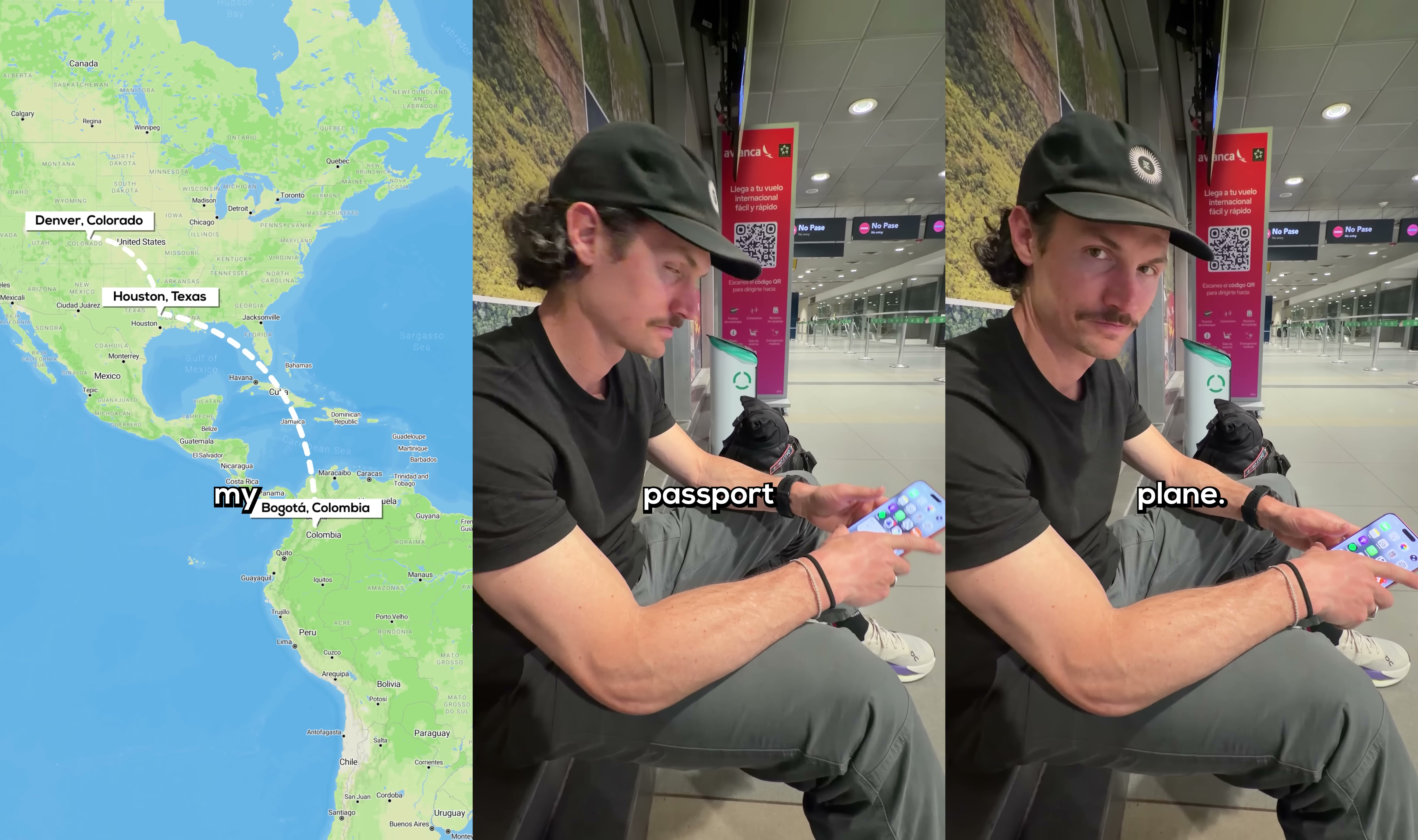
This is the edit's clearest economy decision, and it works by subtraction. Logistics are compressed into a graphic, exposition is compressed into caption fragments, and the only b-roll kept is the kind that carries emotion — a man staring at his phone — rather than information. Music-driven travel reels solve the same compression problem differently, hopping location to location on the beat as in Sydney Sweeney's winter travel reel; that variant buys mood at the cost of causality, while the map keeps it: a mistake made in one city visibly threatens a hotel on another continent.
The Gate: A Room You Have to Climb Down To
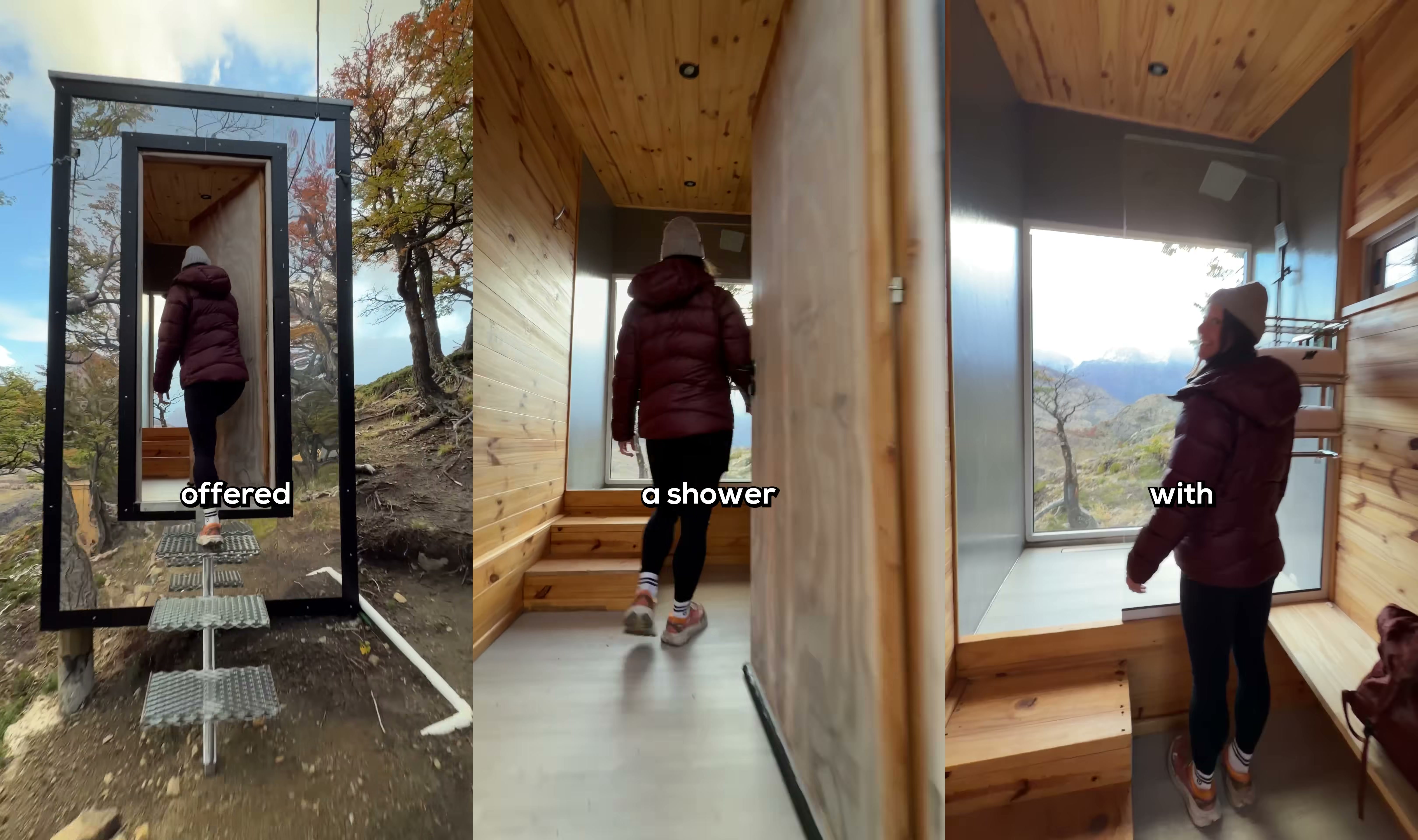
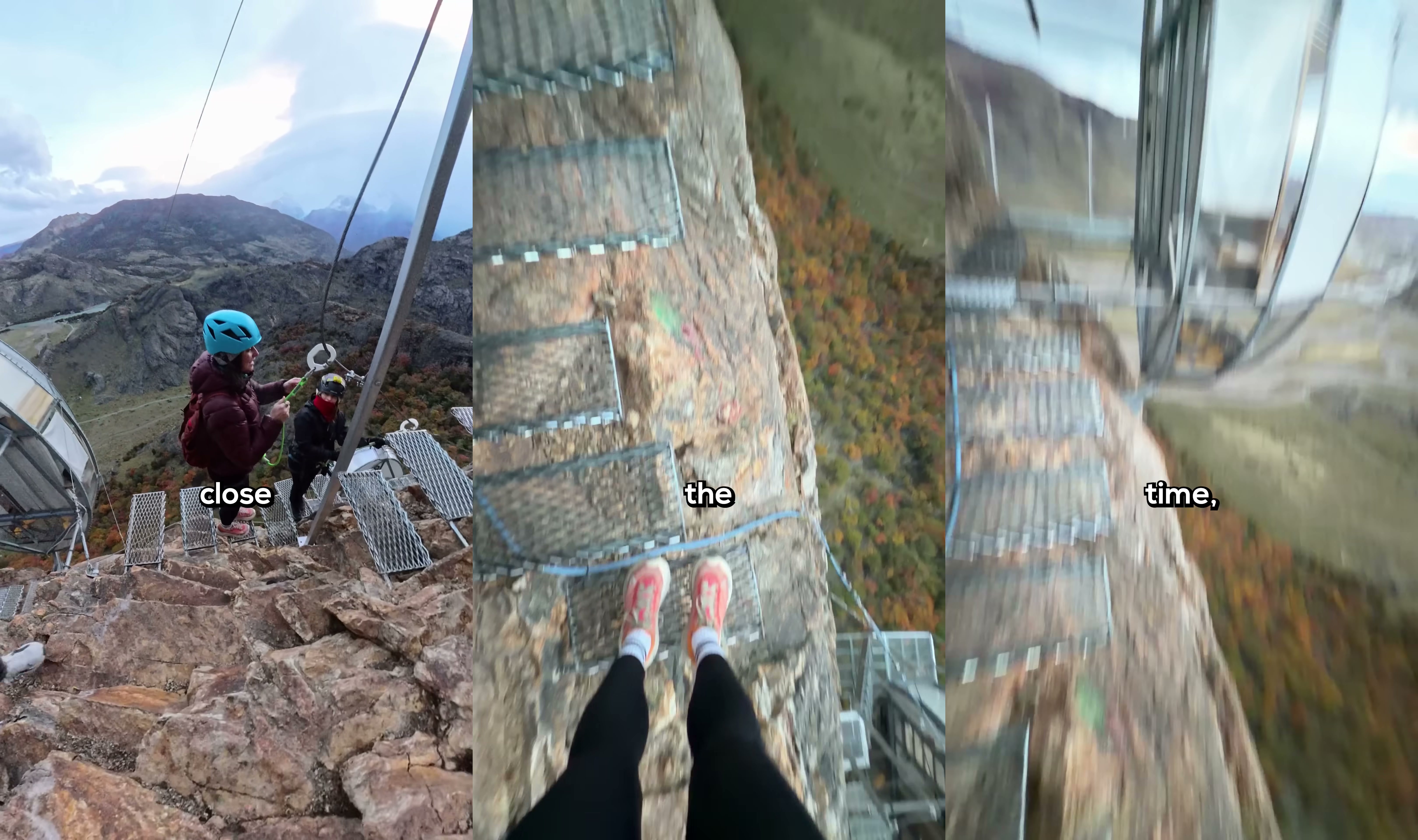
The middle act runs a two-step reveal, and each step is a piece of filmable evidence. At about 38 seconds comes the tease: a glass-walled shower perched on the mountainside, reached by grated steps bolted to open rock, caption fragments reading "offered a shower with …". Eight seconds later comes the gate itself: first-person frames of legs stepping down metal rungs fixed to the cliff, the drop to autumn forest framed directly beneath the climber's feet. The claim is structural, not verbal — this room is not purchased and delivered, it is descended into, and the footage shows the descent that buys it.
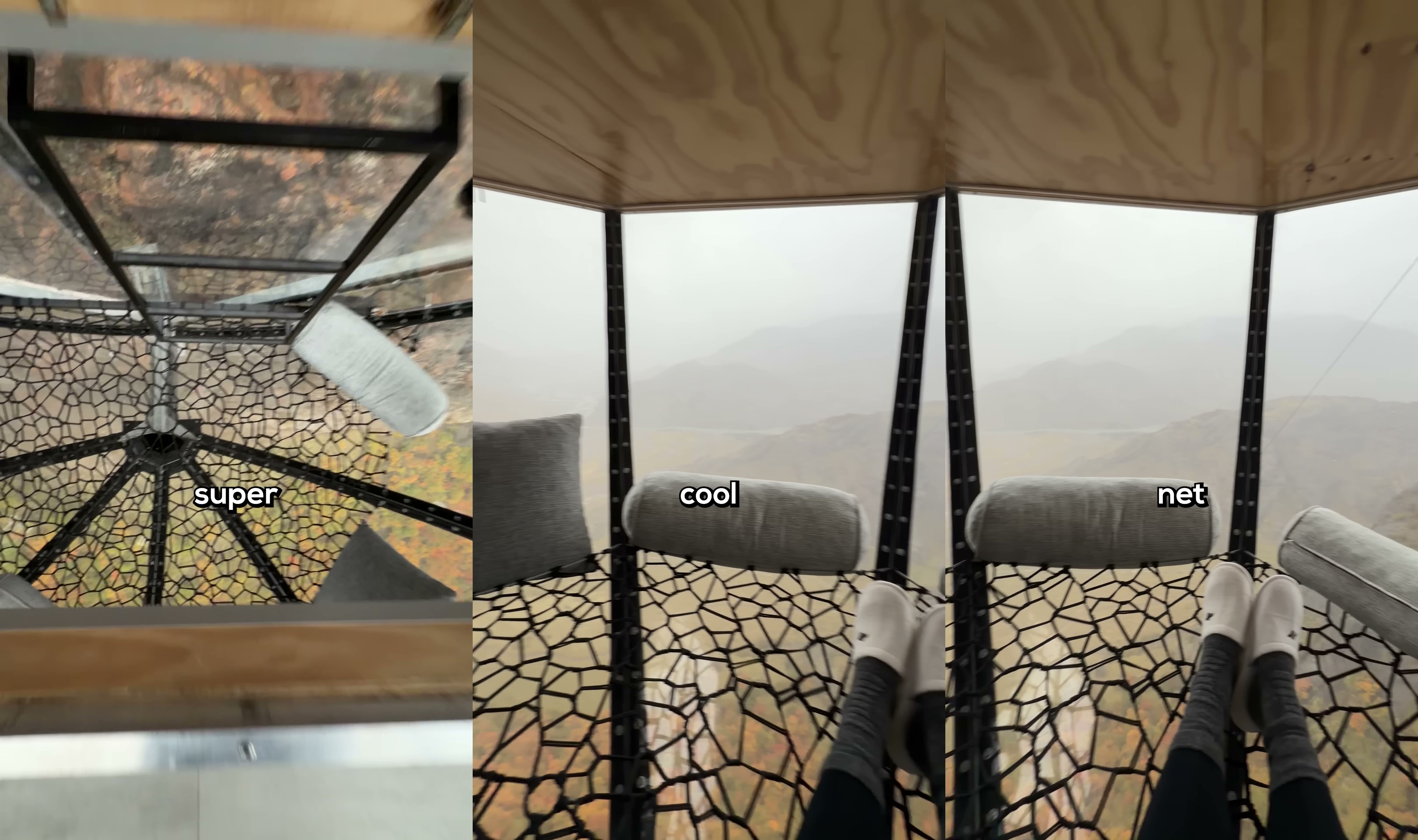
The payoff interior keeps restating the same height after the climb is over. The pod tour's most quotable frame is its floor: at around 62 seconds, a point-of-view shot of bare legs stretched on a rope net with the valley visible through the mesh, caption fragments reading "super cool net". The architecture answers the viewer's unspoken logistics questions — where do you sleep, what happens if you drop something — while the net itself keeps the abyss in every interior shot. A much compressed cousin of this journey-then-gate shape, running in under 20 seconds, appears in Jake Paul's heliskiing short; the scale differs, the gating logic is the same.
Wind, Proven by a Wine Glass
The overnight beat poses a specific problem: dinner inside the pod while a windstorm hammers it. A camera cannot photograph wind — it can only photograph what wind moves, and the object this edit chose is a wine glass vibrating on the dinner table. That single prop converts an invisible condition into visible evidence: no narration, no on-screen wind speed, just trembling glass set against a warm interior. It is the same evidence-logic the whole short runs on — captions over explanation, objects over adjectives — compressed into one two-second shot you could find with the sound off.
An Ending That Declines to Answer
The closing beats are quiet: morning coffee in mountain light, a final drone view of the pods at dusk, and a question — "was it worth it?" — that nobody on screen answers. The cut lands before any verdict, which hands the video's judgment call to the viewer; the comment section becomes the final scene. Whether that was the intent is not observable from the frames. What is observable is the omission: the one sentence a conventional travel edit ends on — some version of "totally worth it" — never arrives, and its absence is the most deliberate cut in the piece.
What One Short Can and Cannot Tell You
This analysis rests on a single 88-second sample and dated snapshots of its numbers, and it should be read that way. It documents what one edit contains — not a channel-wide method, and not a promise that cutting this way produces these view counts. The transferable units are decisions rather than assets: state the superlative only after the impossible frame; replace logistics with one map graphic; put a visible gate between the viewer and the payoff; prove invisible conditions with a prop; end on the question you refuse to answer. None of these requires a Patagonia permit, a drone fleet, or this couple's on-screen identity — and copying the destination, the captions, or the personas would be copying the parts that do not transfer anyway.
Full disclosure: we build Sparki, a conversational video editor, and its copy-style feature exists for exactly this move — it analyzes a reference edit's cutting recipe and applies it to your own footage, borrowing the recipe rather than the content. The general technique is walked through in copy video editing style from a reference. As for the short itself: the view count is the output. The input is an edit in which every claim arrives with its proof attached — and that, not the destination, is the part worth studying.
https://sparki.io/blog/viral-travel-adventure-kara-nate