
Commentary Video Editing Burnout: How Chat-to-Edit AI Replaces the Timeline
Stop the "3 AM editing" grind. See how Sparki's Chat-to-Edit agent automates pacing, B-roll finding, and filler cleanup for commentary videos—no timeline needed.

The 3 AM Editing Reality
I just spent 8 hours editing a 12-minute commentary video. My viewers will probably skip most of it anyway.
If you've ever made commentary videos, this probably sounds familiar. Recording is rarely the hard part. The real burnout starts after — when you open the timeline and realize that the creative work is over, and the janitorial work has begun.
Every small decision costs time: trimming pauses, syncing audio drift from remote guests, deciding where to cut, where to zoom, and agonizing over whether adding one more effect helps retention or just adds noise.
For creators on older or low-end machines, this pain is amplified — when timeline scrubbing itself becomes laggy or unstable, finishing an edit can feel impossible. If that sounds familiar, this low-end laptop video editing guide breaks down realistic ways to finish edits without fighting your hardware.
For years, creators treated this as a discipline problem.
In reality, it's a workflow problem.
The industry standard is the brutal "Rule of 60": for every 1 minute of high-quality finished video, you spend roughly 60 minutes editing. For a weekly commentary channel, that math simply doesn't work.
To understand whether AI can genuinely replace timeline-based editing — not in theory, but in practice — I tested Sparki in two real commentary setups that cover almost all creator use cases.
The Two Hidden Time-Sinks in Commentary
Before we get to the test results, we need to define why editing commentary is so slow. It usually comes down to two specific bottlenecks that traditional Non-Linear Editors (NLEs) like Premiere or DaVinci Resolve can't solve:
The Semantic B-roll Hunt
When you say "The housing market is crashing," you don't just need any house. You need a specific visual mood. A human editor spends hours tagging and searching their library. Traditional software sees files; it doesn't see meaning.
The Pacing Paradox
Over-editing kills retention. Creators often confuse "more cuts" with "better pacing," leading to visual fatigue. The challenge isn't making cuts; it's knowing when to let the footage breathe.
The Test: Two Setups, Two Completely Different Problems
Most commentary creators fall into one of these two categories. They look similar on the surface, but from an editor's perspective, they are fundamentally different problems.We ran the same core script through both workflows to see if the AI Agent could tell the difference.
Automatic Dialogue Cleanup (The Filler Cleanup Pass)
One of the most painful parts of commentary editing isn't storytelling — it's dialogue cleanup.
Before any real pacing or narrative work can begin, editors are forced to run a full cleanup pass : hunting down um, uh, emm, repeated phrases, false starts, and awkward micro-pauses. It's necessary, invisible work — and it's where hours quietly disappear on the timeline.
In our test, Sparki handled this automatically.
Instead of blindly deleting every pause, the agent performed a true filler cleanup : removing meaningless disfluencies while preserving natural breaths, emphasis, and speaking rhythm. The delivery felt tighter and more confident — not rushed, robotic, or overly compressed.
This single capability replaces an entire manual cleanup pass — the kind editors dread most, but can never skip.
Scenario 1: Editing a Talking-Head Commentary (First-Person)
In a first-person talking-head video, the speaker is the visual anchor. The goal isn't to tell a story with images — it's to keep attention without exhausting the viewer.This is where most creators confuse effort with progress.
The Old Way (Manual):
-
Manually cutting out silences and "ums."
-
Creating a "zoom" keyframe every 15 seconds to fake visual variety.
-
Manually typing out subtitles for emphasis.
The Sparki Agent Way (Test Results):When we uploaded the footage and selected "First-person Narration," Sparki fundamentally changed its strategy:
-
Micro-Pacing, Not Just Cutting: It didn't just chop silence (which creates a jerky, robotic feel). It preserved natural breaths while tightening the gaps, creating a rhythm that felt conversational.
-
Fatigue Management: It applied subtle punch-in zooms (1.1x scale) at semantic turning points. It didn't zoom randomly; it zoomed when the argument shifted intensity.
-
Restrained Accent Text: Text did not appear on every sentence. It showed up only where it mattered:
-
The $320k revenue figure
-
The 7-step framework
-
The final Call-to-Action
-
-
Zero Distractions: It prioritized the speaker's eye contact, avoiding inserting random B-roll that would distract from the argument.
Verdict: The result didn't feel AI-edited. It felt like a creator had done the final polish manually.
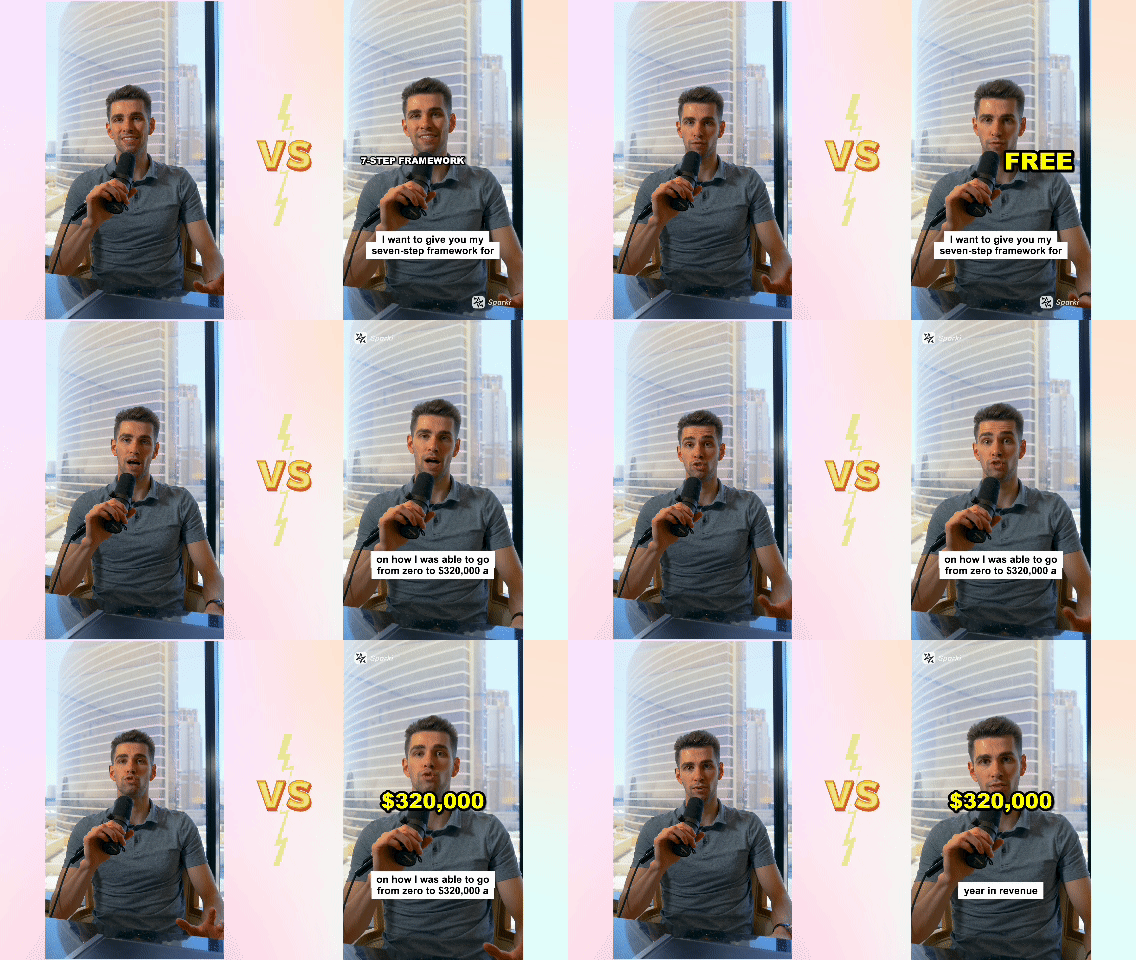
The left shows untouched raw commentary footage. The right shows the result after Sparki’s Chat-to-Edit agent completes its first-pass edit — including dialogue cleanup, context-aware screen zooms, automatic accent text extraction, and pacing adjustments. No manual timeline edits were performed.
Scenario 2: Editing a Story-Driven Commentary (Master Narration)
For the second test, I switched to a Master Storyteller setup: voice + B-roll, where visuals carry the narrative. This is where most AI editors fail — either overusing effects or treating B-roll as random decoration.
This is where the editor stops shaping meaning and starts managing files.The Old Way (Manual):
-
Listening to a sentence.
-
Pausing.
-
Searching a hard drive for "city rain mood."
-
Dragging it in.
-
Realizing it doesn't match the color temperature.
-
Repeating 500 times.
The Sparki Agent Way : This is where the agent capability shined. Sparki behaved very differently than in the talking-head test:
-
Semantic B-Roll Finder: Powered by a multimodal AI model like Gemini 3 Pro, the agent "watched" the uploaded library. When the script mentioned "economic downturn," it didn't look for a file named economy.mp4. It found a shot of a closed storefront from the user's footage that visually matched the mood.
-
Narrative Layering: B-roll became the primary layer. The talking head was used sparingly, cutting back only as an emotional anchor or transition.
-
Paragraph-Level Logic: The Agent interpreted the script at a paragraph level , not sentence by sentence. Instead of reacting to individual lines, the edit followed a clear structure: Context → Requirements → Framework → Outcome.
Verdict: That's the difference between clipping footage and making editorial decisions.
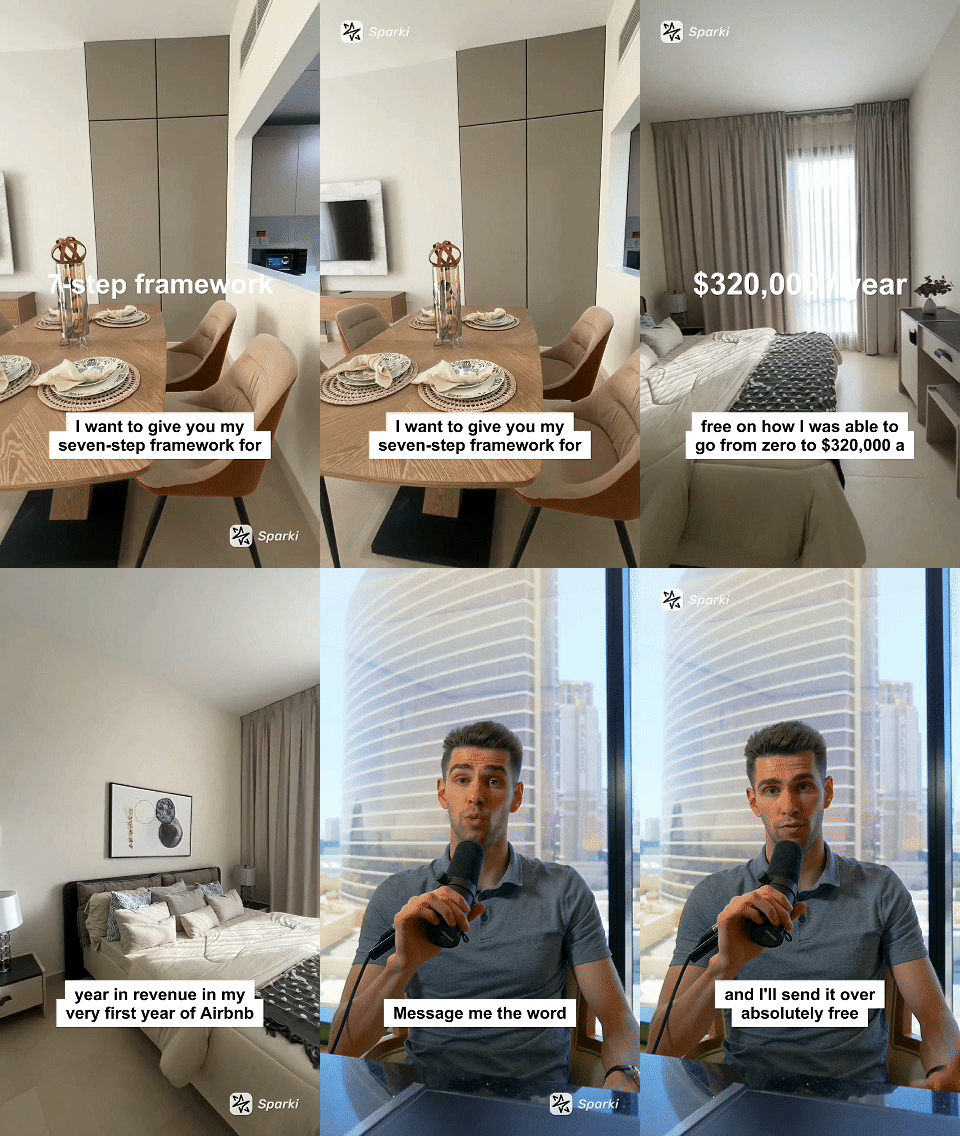
Sparki’s editing agent automatically decides when to stay on the talking head and when to introduce B-roll, based on narrative context and viewer attention. Visuals are selected from the creator’s uploaded assets, ensuring the right footage appears at the right moment—without manual timeline decisions.
The Chat-to-Edit Experience: What It Actually Looks Like
The biggest shift isn’t the output — it’s the responsibility.
Sparki takes ownership of the editing by default.
It automatically performs the full first pass: dialogue cleanup, pacing, cuts, zoom logic, and visual emphasis — without you explaining how to edit.
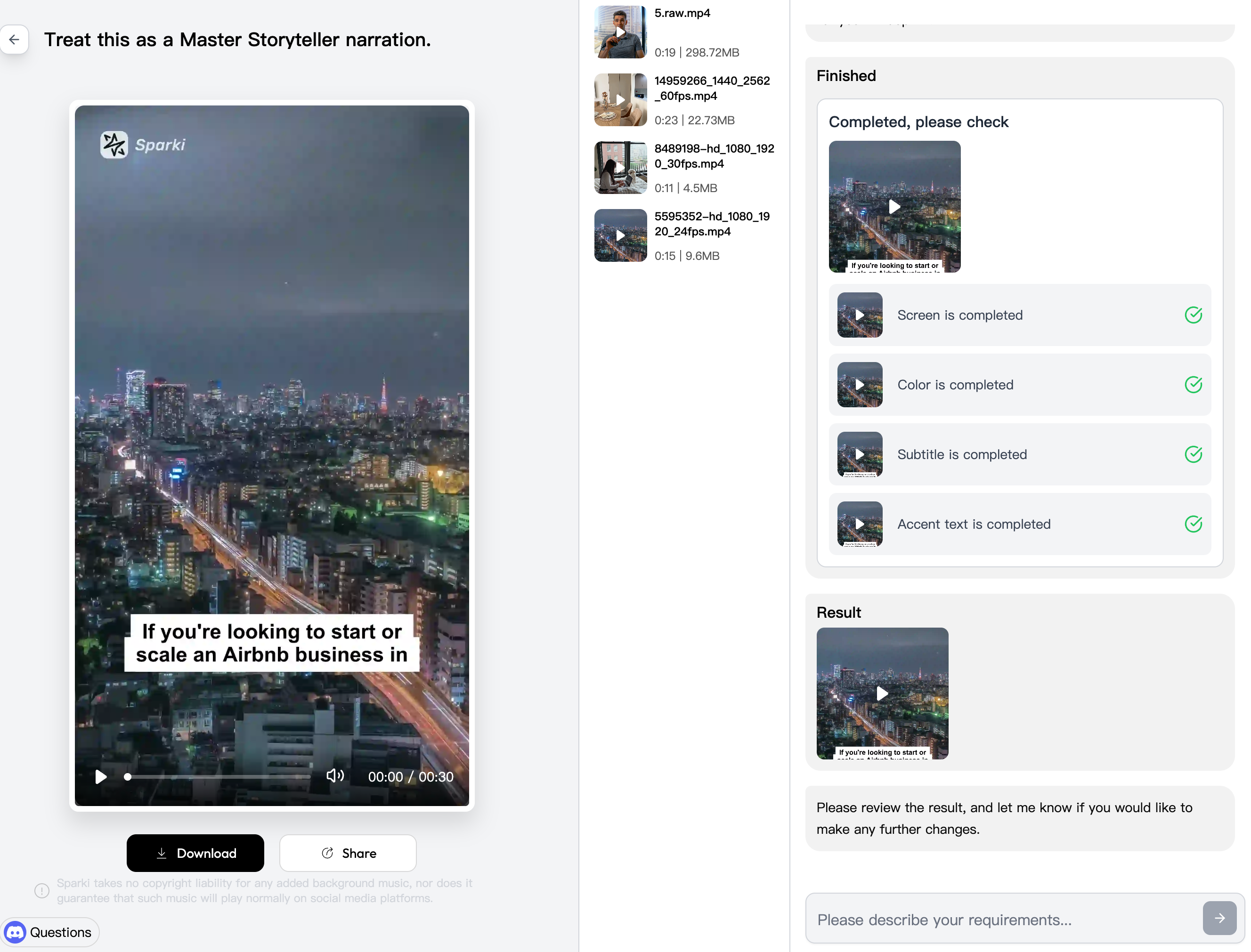
Sparki’s chat-to-edit interface automatically handles color grading, aspect ratio adaptation, captions, pacing, and visual emphasis for commentary videos. Creators can optionally refine any detail through simple text instructions—no manual timeline work required.
If you’re happy with the result, you do nothing.
If you want something more specific, you don’t dive into a timeline — you give direction.
Instead of hunting for the "Razor Tool" or "Ripple Edit," your workflow looks like this:
Task: Fixing the Intro
-
Timeline Way: Unlink audio/video, drag select, delete ripple, drag clips back to start.
-
Sparki Way: Texting "The intro feels too slow. Cut the first 30 seconds and start directly with the hook about revenue."
Task: Adding B-Roll
-
Timeline Way: Open finder, search, preview, import, drag to V2 track, resize, color correct.
-
Sparki Way : Texting "Cover the section about 'urban decay' with my drone footage from Chicago."
This is why we call it an Agent , not a tool. You reason with it.
Why "Restraint" Matters More Than Effects
Most AI video editors try to impress you by adding effects everywhere. They assume more editing = better video.
Sparki's strength is knowing when notto edit.
Restraint is not a missing feature in Sparki — it is a deliberate design principle.
-
Accent text is semantic-driven, not subtitle-driven. (It knows that "and then" doesn't need to be popped on screen).
-
Zoom is used as a pacing tool, not decoration.
-
Color grading focuses on global consistency, ensuring the B-roll matches the A-roll, rather than applying aggressive filters.
Nothing fights for attention. This restraint is what makes the video feel finished , not templated.
Comparison: Timeline vs Agent
To summarize the shift, here is how the two approaches stack up for a typical commentary video:
| Task | Timeline Editing (Manual) | Agent Editing (Sparki) |
|---|---|---|
| Rough Cut | 2-3 hours of "Janitorial Work" (culling) | Instant automated pass based on transcript |
| B-Roll Search | File-name based search (tedious) | Semantic visual search (Gemini 3 Pro) |
| Pacing | Manual keyframing for zooms | Context-aware "Fatigue Management" |
| Audio Sync | Manual nudging / Clapping | Auto-detection of multi-source drift |
| Your Role | The Operator (Clicking buttons) | The Director (Making decisions) |
How to Try This Yourself (Takes 2 Minutes)
If you want to see the difference immediately, you don't need a tutorial.
-
Upload a talking-head commentary → choose First-person Narration.
-
Upload a commentary with B-roll → choose Master Storyteller Narration.
-
Use one simple instruction:
Enhance pacing without changing the spoken content.
You'll instantly feel the difference between template editing and decision-based editing. If you're burned out by timelines, Sparki is worth testing — not because it promises smarter editing, but because it actually delivers finished videos.
https://sparki.io/blog/chat-to-edit-commentary-video-editing