
Instagram Reels Specs 2025 & How to Cut Editing Time by 90%
Stop the "Rule of 60" burnout. Get the exact 2025 Reels specs and see how Sparki's Chat-to-Edit agent turns raw footage into viral shorts instantly.

If you dread opening your video editor, it’s not a discipline problem—it’s a math problem. Industry pros call it the "Rule of 60" : for every 1 minute of finished video, you spend roughly 60 minutes on "janitorial work" like culling bad takes, syncing audio, and resizing footage.
This manual labor is the Willpower Tax that kills your consistency.
In 2025, the fix isn't to edit faster; it's to stop doing the grunt work entirely. This guide shows how to use AI Video Agents (like Sparki) to break the Rule of 60, letting you "Chat-to-Edit" your raw footage into viral Reels in minutes—not hours.
1. Reels Specs Cheat Sheet: Length, Aspect Ratio, Resolution
Before creativity and storytelling, the technical constraints must be correct. Uploading the wrong format often leads to compression artifacts, UI overlays covering text, and lower reach.
Core specs for Instagram & Facebook Reels (2025)
| Platform | Max length (most accounts) | Aspect ratio | Recommended resolution | Typical frame rate | | Instagram Reels | 90 seconds (some accounts up to 15 minutes) | 9:16 | 1080 × 1920 px | 30 or 60 fps | | Facebook Reels | 90 seconds | 9:16 | 1080 × 1920 px | 30 fps | | YouTube Shorts | 60 seconds | 9:16 | 1080 × 1920 px | 30 fps | | TikTok | Up to 10 minutes | 9:16 | 1080 × 1920 px | 30 fps |
Key editing implications:
-
Always work in vertical 9:16, 1080 × 1920. Avoid uploading landscape with black bars.
-
Keep text and faces out of the top and bottom UI zones.
-
Export at 30 fps by default; use 60 fps for very dynamic footage if your source supports it.
Note: Memorizing these numbers is the old way. In the workflow below, I’ll show you how an AI Agent standardizes these settings automatically, so you never have to worry about 'safe zones' or resolution again.
2. The "Chat-to-Edit" Workflow: Replacing the Timeline with an Agent
Memorizing the specs in the table above is the old way. The new way is to let an Agent handle the math so you can focus on the story.
To make this concrete, imagine the following scenario: You have just recorded a 60-minute podcast episode or a long vlog. You know this needs to become multiple Reels for Instagram, TikTok, and Shorts, but manually cutting it down feels overwhelming.
Here is how Sparki’s "Chat-to-Edit" breaks the Rule of 60 by treating editing as a conversation, not a timeline.
Step 1: Multimodal Ingest (The "Smart" Analysis)
You upload the full 60-minute video into Sparki. Unlike older tools that only read the transcript, Sparki uses Gemini 3 Pro to perform a multimodal analysis—meaning it "watches" your video the way a human does.
Behind the scenes, the system:
-
Sees the context: It identifies visual elements (e.g., recognizing "economic downturn" imagery vs. "happy" imagery).
-
Hears the intent: It detects emotional peaks, laughter, and strong claims.
-
Flags the hooks: It identifies the strongest potential openers (e.g., "We doubled revenue by changing just one line").
Instead of staring at a blank timeline, you see a structured outline of your content, ready for direction.
Step 2: The "Junior Editor" Brief (Create Once, Post Everywhere)
This is where you execute the "Repurposing" strategy without the manual grind. Instead of dragging clips, you act as the Director giving instructions to a Junior Editor.
You describe your intent in natural language:
-
Extract the section about 'UGC strategy' and make it a standalone Short.
-
Find the funniest reaction moments and compile them into a highlight reel.
This replaces the traditional Edit Decision List. You aren't "making one Reel"; you are installing a system that turns every long-form asset into 5–15 short-form clips with minimal incremental effort.
Step 3: Automatic Assembly (Escaping "Janitorial Work")
The Agent executes the rough cut instantly. This is where the "Rule of 60" is broken. Sparki handles the "Janitorial Work" that usually burns editors out:
-
Smart Culling: It removes dead air, filler words ("um", "uh"), and awkward pauses without making the pacing feel robotic.
-
Structure: It reorders clips for clarity (Hook → Context → Payoff).
-
Smart Framing: It automatically reframes the shot for 9:16, keeping the speaker’s face in the "sweet spot" and avoiding UI overlays.
-
Dynamic Captions: It burns in subtitles that match your brand style, ensuring the video is watchable on mute.
Step 4: Conversational Revisions (You Direct, It Executes)
Most AI tools fail here because they give you a "take it or leave it" result. Sparki allows for Human-in-the-loop refinement.
You refine the edit by texting feedback:
The second Reel feels rushed. Enhance pacing without changing the spoken content.
The hook is too aggressive. Start with the joke about the marketing budget instead.
Cover the awkward jump cut with that B-roll of the city skyline.
The AI regenerates the edit while preserving the rest of the structure. You stay focused on clarity and positioning, not keyframes.
Step 5: Export for Every Platform
Finally, you export clean master files that are platform-perfect by default:
-
Resolution: 1080 × 1920 (9:16)(Note: Specific output resolution depends on the resolution of your uploaded source footage).
-
Watermark-Free: Premium users export clean files ready for cross-posting to Reels, TikTok, and Shorts without algorithmic penalties.
By the end of this workflow, you haven't just "edited a video." You've turned one recording session into a full week of content—in minutes, not hours.
3. Why Sparki Understands Viral Metrics Better Than You
Humans edit based on "feeling." Sparki edits based on attention data. Here is how the Agent applies viral psychology to your footage automatically.
3.1 The 2-Second Hook (Powered by Semantic Analysis)
Across platforms, attention is won or lost in the opening frame.
-
The Data: TikTok reports that ~50% of ad impact happens in the first 2 seconds. If the hook fails, the scroll happens.
-
The Sparki Difference: Instead of you manually hunting for a "good part," Sparki uses Gemini 3 Pro to perform semantic analysis. It scans your footage for "High-Energy" moments, emotional peaks, or strong verbal claims, and places them at the very start. It doesn't just guess; it calculates the highest probability of stopping the scroll.
3.2 Pacing: "Micro-Pacing" vs. "Jump Cuts"
Many creators confuse "fast editing" with "good pacing," leading to choppy, robotic videos that exhaust the viewer.
-
The Data: Users disengage when there is "conceptual drift" or dead air, but they also leave when the video feels overly compressed and unnatural.
-
The Sparki Difference: Sparki uses a technique called Micro-Pacing.
-
It removes "ums," "ahs," and dead air, but preserves natural breaths to keep the rhythm conversational.
-
It applies "Fatigue Management" zooms (punch-ins) not randomly, but at semantic turning points—exactly when the argument shifts intensity.
-
Result: A video that feels tight, but not frantic.
-
3.3 Mobile-First Framing & Safe Zones
Reels are watched on vertical screens, often with the interface overlaying the video.
-
The Data: Mis-framed subjects (covered by the Like button or Caption text) significantly reduce engagement.
-
The Sparki Difference: You don't need to download a "Safe Zone PNG" overlay. Sparki acts as your safety net at the rendering layer. It tracks faces and key actions, automatically reframing landscape footage into 9:16 while keeping text and subjects inside the "UI Safe Zone." If a speaker moves, the camera follows—automatically.
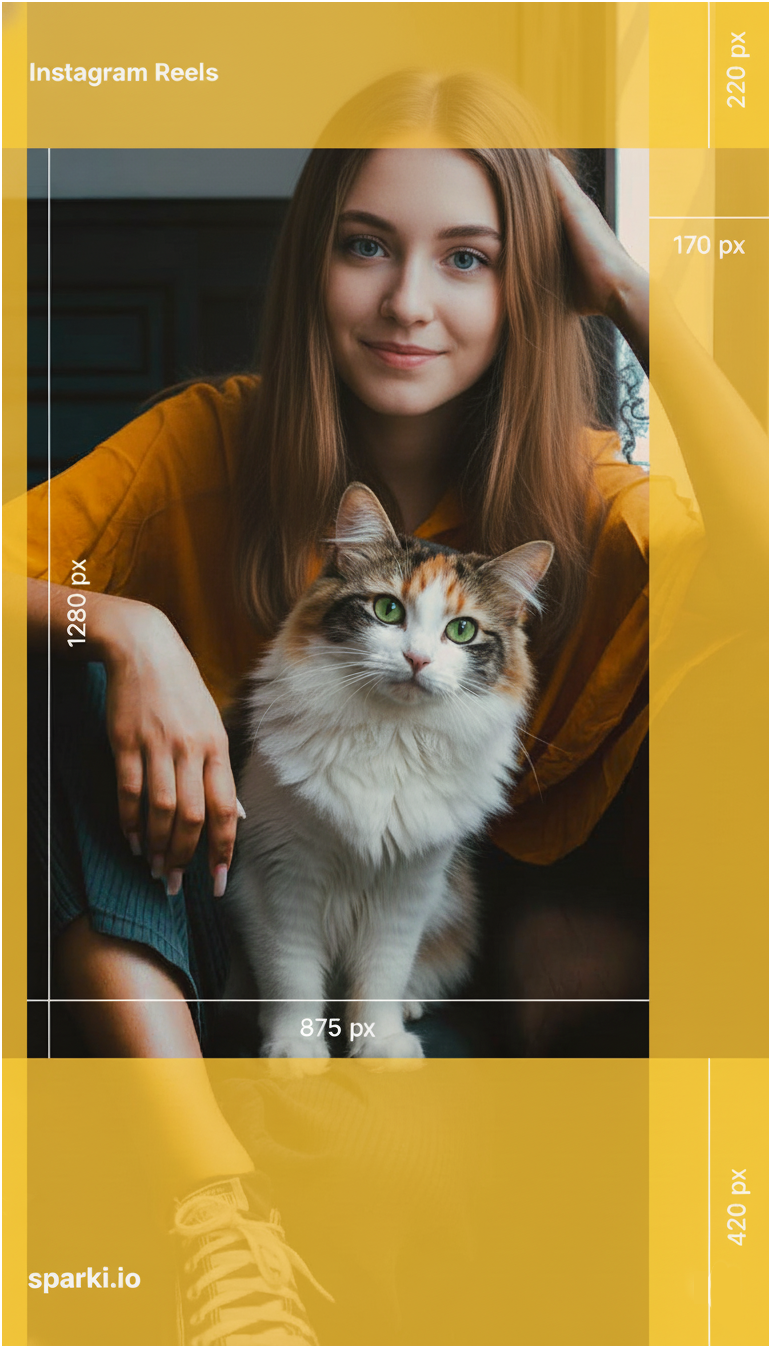
TikTok safe zone guide showing where to place faces, text, and UI-safe content in vertical videos
3.4 Ideal Reel Length: A/B Testing Made Easy
While Instagram allows 90 seconds, data suggests the sweet spot for educational Reels is often 15–30 seconds.
-
The Old Way: Editing a 15-second version and a 30-second version requires two separate manual edits.
-
The Sparki Way: You can now easily configure and select the video length you need. Choose from a 15-second punchy version for TikTok or a 45-second deep-dive for YouTube Shorts. Sparki automatically adjusts your content to fit your desired time constraints, allowing for seamless A/B testing without the manual rework.
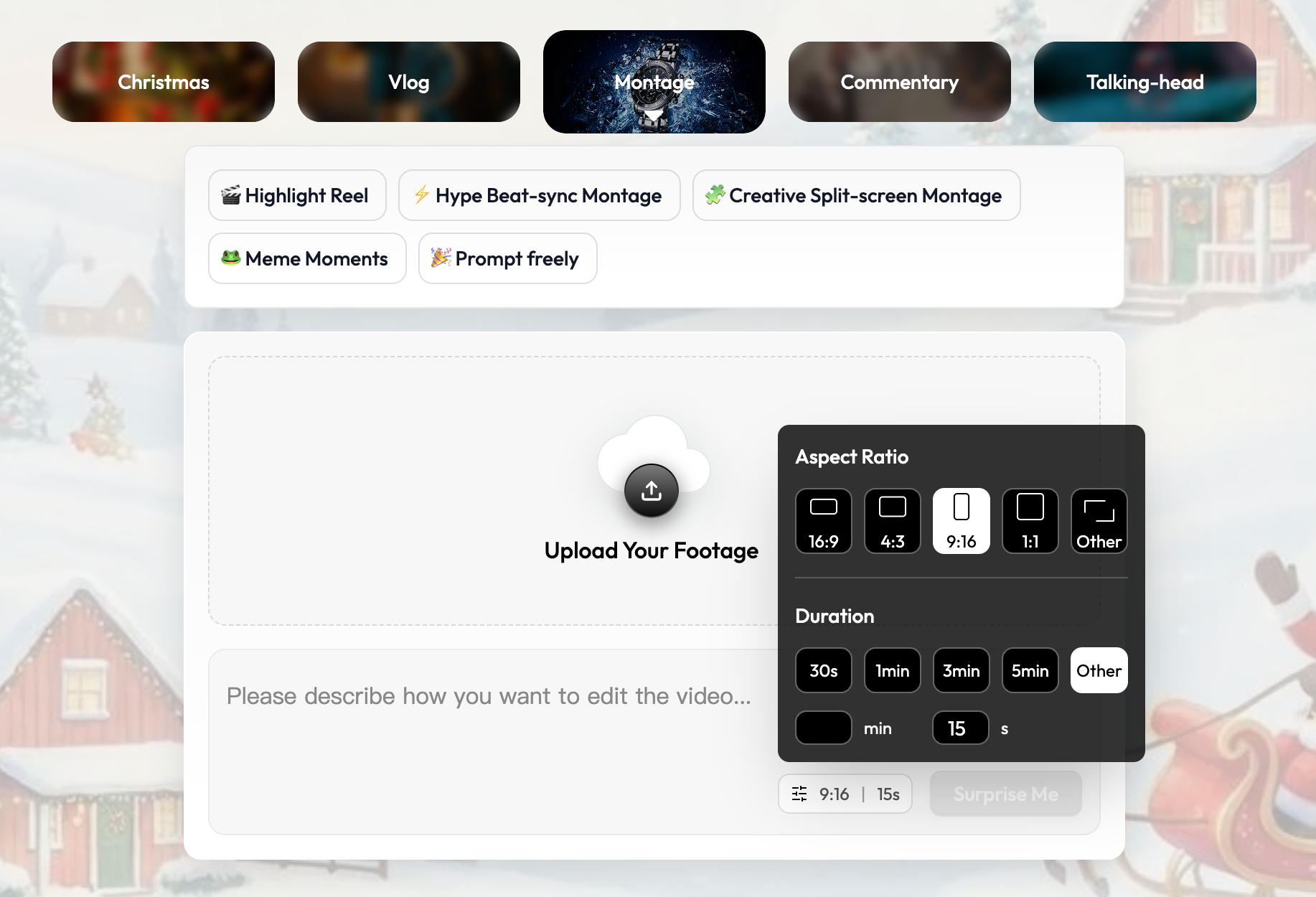
Use Sparki.io to easily create professional video montages. Select your preferred aspect ratio (16:9, 4:3, 9:16, or custom) and duration (30s, 1min, 3min, 5min, or custom) to craft the perfect video content for your needs. Simply upload your footage and describe how you want the video to be edited—Sparki.io will handle the rest with AI-powered editing features tailored to your specifications.
4. The "Willpower Tax": Why Manual Editing Fails
Traditional manual editing assumes you have infinite time and cognitive bandwidth. We call this the "Willpower Tax" : the mental energy you burn just to set up the timeline before you make a single creative decision.
Short-form makes this harder, not easier. Every second must "earn its place," and the editorial load per minute is brutally high.
Common failure points of a manual-only workflow:
-
Decision Fatigue: You settle for a weak hook because you’re too tired to scrub through the raw footage one more time.
-
The "Janitorial" Trap: You spend 90% of your time cleaning up "ums," removing silence, and syncing audio, leaving no energy for storytelling.
-
Format Friction: You upload a horizontal video to Reels because reframing it vertically and checking UI safe zones manually takes too long.
-
Inconsistent Captions: You skip adding subtitles because typing them out feels like a chore, killing your reach on mute-heavy platforms.
The Solution: Be the Director, Not the Operator
Sparki doesn't replace your creative judgment; it dramatically reduces the mechanical labor around these decisions.
-
The Timeline Way: You are the Operator , clicking buttons, moving clips, and fixing tech issues.
-
The Sparki Way: You are the Director , making high-level decisions while the Agent handles the grunt work.
5. Your Sparki "Smart Cut" Checklist
Don't rely on luck. Before you hit export, use this checklist to ensure your Agent delivered a viral-ready edit.
The Automated Layer (What Sparki Did for You):
-
The 2-Second Hook: Did the semantic analysis correctly identify the strongest opening claim or question?
-
Zero "Dead Air": Are all "ums," awkward pauses, and silence gaps fully removed?
-
Fatigue Management: Is there a visual change (a cut, a zoom, or a caption pop) every 3-5 seconds to reset attention?
-
Mobile Safety: Are the speaker's face and key text positioned in the center, strictly avoiding the TikTok/Reels UI overlay zones?
-
Dynamic Captions: Are subtitles perfectly synced to the audio speed?
The Director Layer (What You Need to Verify):
-
The Emotional Arc: Does the video deliver on the promise made in the first second?
-
Rewatchability: Is the ending tight enough to encourage a loop, or does it drag on?
Verdict: If Sparki handled the first 5 points, you only need 30 seconds to check the last 2. That is how you break the Rule of 60.
https://sparki.io/blog/ai-reels-editing-2025